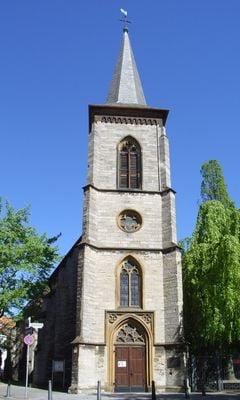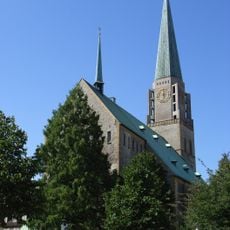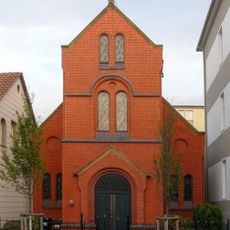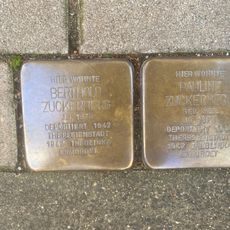
Süsterkirche, Gothic church in Old Town, Bielefeld, Germany.
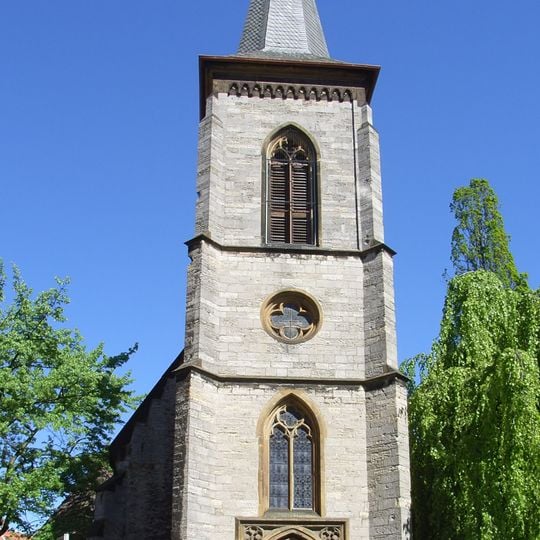
Süsterkirche is the parish church of Bielefeld's Reformed congregation, on Süsterplatz in the northern old town. The late Gothic nave of 1491 has four bays and a polygonal choir with tracery windows and a net vault. A 28-metre west tower by Christian Heyden was added in 1861; the 1892 neo-Gothic transept and choir gave the church its cross-shaped plan. The tower rises in square stages to a dark shingled spire, with a louvered pointed window, a round tracery window and a two-light pointed window below it.
The church grew out of the Mariental convent founded in Bielefeld's old town by Augustinian sisters in 1491; the Low German "Süstern", meaning sisters, gave the church its name. The city took over the convent in 1616, and after the Reformed congregation was founded in 1657 the church passed to it in 1671 as a gift from the Elector. Christian Heyden's 28-metre west tower followed in 1861, and a neo-Gothic transept and choir in 1892 gave the building its cross-shaped plan. Bombing on 30 September 1944 destroyed 72 percent of the church and burned the roof frame.
The name Süsterkirche comes from Low German "Süstern", meaning sisters, after the Augustinian nuns who settled here in 1491. Following Reformed tradition, the interior has no altar, cross, flowers or candles; the choir instead carries a large mosaic made in summer 1929 by Bielefeld artist Georg Tuxhorn (1903–1941). Two memorial tablets in the entrance area commemorate congregation members fallen in the First and Second World Wars, the Franco-Prussian War and colonial wars; in 2019 the congregation placed a glass panel with pacifist and anti-militarist slogans in front of them, prompted by a letter from pupils of the Hans-Ehrenberg School.
The church sits in Bielefeld's Old Town on a main street and is easy to reach on foot. Visitors should check opening times beforehand as the building is not always open to the public.
Instead of a typical baptismal font, the church houses a silver baptismal bowl made in the late 1600s, one of its most precious objects. This piece reflects the craftsmanship and prosperity of the congregation at that time.
The community of curious travelers
AroundUs brings together thousands of curated places, local tips, and hidden gems, enriched daily by 93,359 contributors worldwide.