Schloss Wolfegg, Renaissance castle in Wolfegg, Germany.
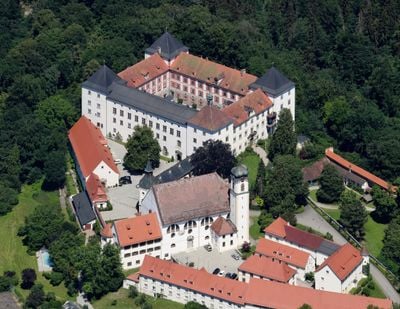
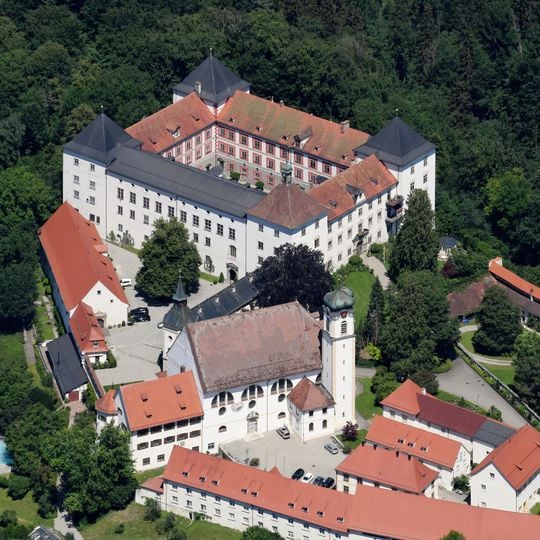
Schloss Wolfegg is a Renaissance castle in Wolfegg, Upper Swabia, built as four wings around a rectangular courtyard with corner towers. Its pale walls, rows of rectangular windows and steep red-tiled roofs are visible from outside; the complex was partly destroyed in 1646 and rebuilt from 1651, so it is not intact. The castle is usually closed to the public.
The castle was destroyed by Swedish forces in 1646 during the Thirty Years' War and suffered severe damage. Rebuilding work began in 1651, progressing slowly due to limited financial resources.
The Rittersaal, or Knights' Hall, is a Baroque hall with 24 life-sized wooden sculptures and large ceiling mirrors. It is named after the knights' hall of the Waldburg-Wolfegg family and is used for concerts, including the Ludwigsburg Palace Festival. In May 2016 the Denkmalstiftung Baden-Württemberg named it Monument of the Month.
The castle opens twice yearly for international classical music concerts held in the Knights' Hall, giving visitors the chance to explore selected interior rooms. These events provide an excellent opportunity to experience the grand rooms and historical setting.
The 1507 Waldseemüller world map, the first to label the new continent America, was found in the castle library in 1901 by Jesuit priest Josef Fischer. It was a 1516 reprint in a bound volume. The Waldburg-Wolfegg family sold it to the Library of Congress in 2001 for ten million dollars.
The community of curious travelers
AroundUs brings together thousands of curated places, local tips, and hidden gems, enriched daily by 94,628 contributors worldwide.