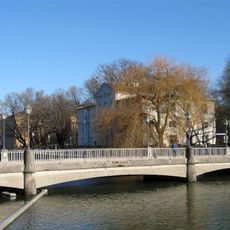
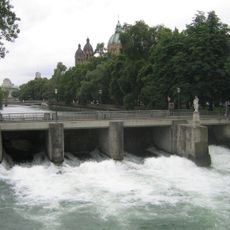
Kabelsteg in München, Pedestrian arch bridge in Au-Haidhausen, Germany.
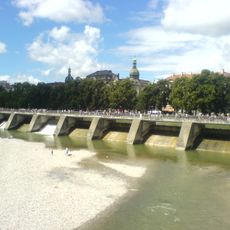
The Kabelsteg is a reinforced-concrete pedestrian bridge with two wide, flat arches, each spanning 37 metres, and a total length of 76.50 metres. It crosses the Kleine Isar between the Kalkofeninsel and the Praterinsel, and its iron railing is designed in Jugendstil forms. An oval opening above the central pier reduces the bridge's weight and its resistance surface during very high floods.
The Kabelsteg was built in 1898 by Wayss & Freytag under licences for reinforced-concrete construction acquired from Joseph Monier. Its design came from municipal building officials Adolf Schwieling and Aquilin Altmann. The bridge survived the Isar flood of 14 September 1899, which destroyed the Luitpoldbrücke and Max-Joseph-Brücke. It is listed as a heritage monument.
The structure shows Art Nouveau characteristics through its curved metal lines and decorative railings that soften its industrial function. These design choices reflect how the bridge was meant to be both practical and visually appealing to people crossing it.
The footbridge crosses only the Kleine Isar, linking the Kalkofeninsel bank with Praterinsel; to continue over the Große Isar to the west bank, use the adjoining Mariannenbrücke. The deck is narrow and reserved for pedestrians, with no vehicle access.
The oval opening above the central pier cuts the bridge's weight and reduces the surface exposed to a very large flood; its shape also echoes the curve of the whole structure. The bridge withstood the flood of 14 September 1899, which destroyed the Luitpoldbrücke and Max-Joseph-Brücke.
The community of curious travelers
AroundUs brings together thousands of curated places, local tips, and hidden gems, enriched daily by 93,861 contributors worldwide.