Luitpoldpark, Park and architectural heritage monument in Schwabing-West, Munich, Germany.
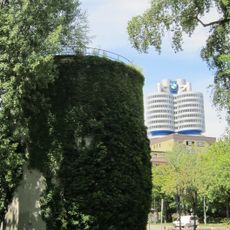
Luitpoldpark is a 33-hectare public park in Munich's Schwabing-West district. Its broad lawns and dense clusters of leafy trees are crossed by pale, straight paths. Scattered among the greenery are a low white building with a flat roof, a larger grey complex with a central courtyard, a long low structure with a red roof, and a tall white block with many windows. In the north, the 37-metre Luitpoldhügel rises as a viewing point.
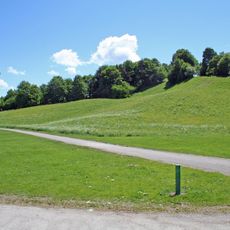
The park was created in 1911 to mark the 90th birthday of Prince Regent Luitpold of Bavaria. After World War II, rubble from the destroyed city was piled up on the grounds, forming the hill that now shapes the landscape of the northern section.
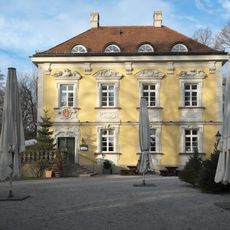
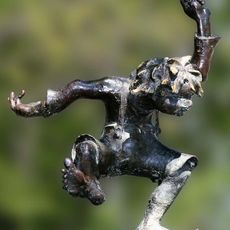
The Bamberger Haus at the western edge of the park opened in 1911 as a café, its design modelled on a house in Bamberg. Bombed in World War II, it was rebuilt in the 1980s. A hedge maze lies next to it, and the Pumuckl fountain nearby spits water at unpredictable moments.
The park is a short walk from the Scheidplatz subway station and is open year round. The paths are mostly flat around the edges, though the central hill requires a bit of climbing, so wearing comfortable shoes is a good idea.
The obelisk honouring Prince Regent Luitpold was carved by Heinrich Düll and Georg Pezold from Lower Franconian shell limestone and bronze, and it formed the core of the park laid out in 1909. It was ringed by 90 lime trees, one for each year of Luitpold's life, and 25 oaks.
The community of curious travelers
AroundUs brings together thousands of curated places, local tips, and hidden gems, enriched daily by 94,643 contributors worldwide.