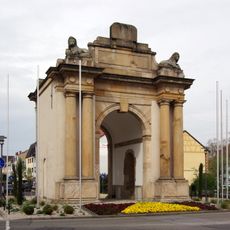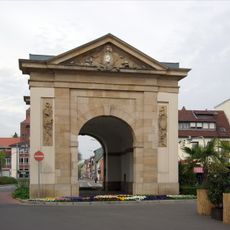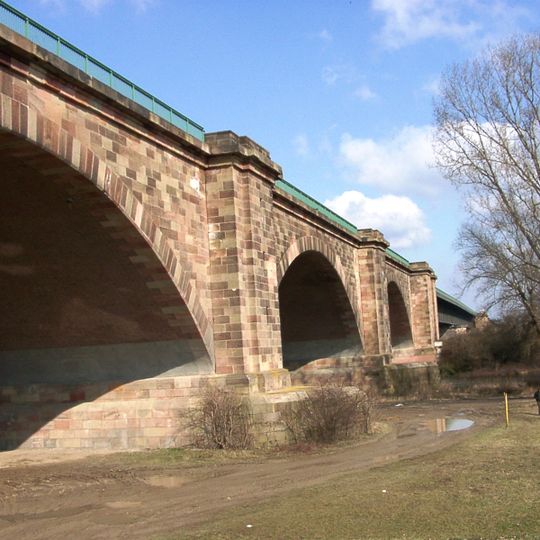
Theodor Heuss Bridge, Steel bridge over the Rhine River near Frankenthal, Germany.
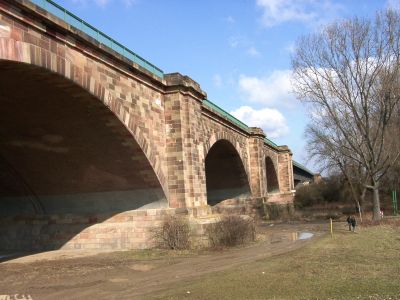
The Theodor Heuss Bridge carries Autobahn 6 over the Rhine between Frankenthal and Mannheim. Its 830-metre length combines two approach viaducts with three and six masonry arches, faced in red sandstone, and a steel girder main span with fields of 147 and 161 metres. A walkway runs along the central reservation, reached by stairs in the abutments.
Construction began in 1938 to a design involving architect Friedrich Tamms. On 12 December 1940 a launching frame collapsed between the river pier and the Mannheim bank pier, killing about 30 workers, and work stopped during the Second World War. It resumed in April 1949; the first two-lane carriageway opened on 9 September 1950, and all four lanes were finished in 1964.
The bridge is named after Theodor Heuss, who was not pleased that it was named for him during his presidency and without his consent. The naming was applied when the first carriageway opened in 1950, days before Heuss visited the bridge.
The bridge carries busy Autobahn traffic and experiences heavy congestion during peak hours, so plan accordingly if driving. The pedestrian and cycling path offers a separate experience and is the best way to see the structure up close.
The bridge has a walkway along its central reservation, reached by staircases built into the piers of both abutments. It is one of the few Rhine crossings where pedestrians and cyclists can cross the river on the motorway itself. The steel girder main span set a world record for plate-girder bridges when built.
The community of curious travelers
AroundUs brings together thousands of curated places, local tips, and hidden gems, enriched daily by 94,898 contributors worldwide.