Ulrepforte, Medieval city gate in Altstadt-Süd, Cologne, Germany.
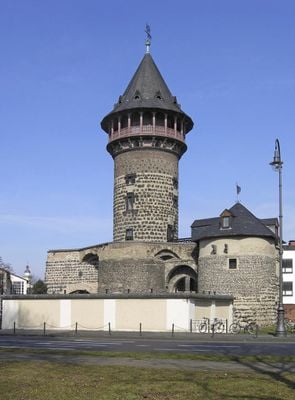
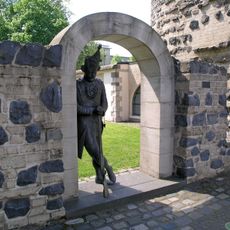
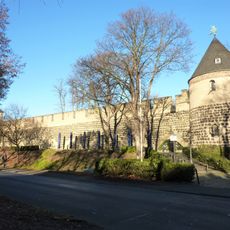
The Ulrepforte is a gate of Cologne's medieval city wall, built around 1230 with a passage about four metres wide, the narrowest of the city's landward gates. Its two half-towers flank the wall, and a 23.5-metre mill tower with a steep conical roof and a band of reddish-pink balustrade stands on the city side. A dark metal statue of a figure in a long coat and pointed cap, holding a staff, stands in the rounded stone archway.
The Ulrepforte was built around 1230 as one of the first gates of Cologne's medieval wall and was first mentioned in 1245. Around 1450 the gate was walled up and converted into the Carthusian Windmill; a 23.5-metre mill tower was added to the northern half-tower. In 1886 Franz Carl Guilleaume had it restored by Vincenz Statz and opened a wine tavern there.
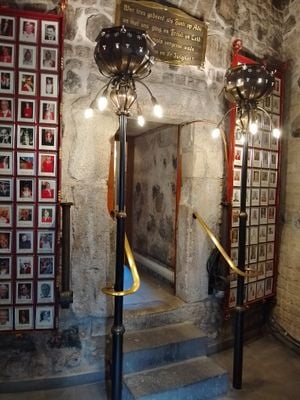
The name Ulrepforte derives from the "Ulner" (also Üler or Euler), potters who had to work outside the built-up area because of fire risk; until the early 19th century this district was used for gardening and farming. Since 1956 the gateway has been the home base of the Kölsche Funke rut-wieß vun 1823 carnival society, which leased it after the war and had it cleared of rubble from 24 September 1955.
The building is accessible across multiple levels connected by stairs that link the different spaces and the courtyard. Visitors should be prepared for uneven historic floors and occasional steps as you move between different areas.
The name derives from the "Ulner" (also Üler or Euler), the potters who had to work outside the built-up area because of fire risk. The gate itself was only about four metres wide, the narrowest of Cologne's landward city gates, and no country road led to it, so it probably had little traffic significance.
The community of curious travelers
AroundUs brings together thousands of curated places, local tips, and hidden gems, enriched daily by 93,359 contributors worldwide.