Warnemünder Vogtei, Bailiff's house in Warnemünde, Rostock, Germany
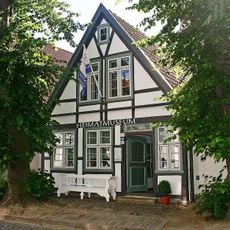
The Warnemünder Vogtei at Am Strom 59 is a plastered, eaves-facing building with a gabled roof and partial timber framing on its upper floor. Its two-aisled cellar with cross-ribbed vaults and the granite blocks in the ground-floor masonry date from 1605, while foundations found in the 1990s go back to around 1300. It was the only transverse house in Warnemünde; all others faced the Warnow with their gables.
A bailiff of Mecklenburg's Prince Heinrich II, called Ludberg Starkader, resided near Warnemünde before Rostock bought the village on 11 March 1323. Rostock then installed its own bailiff, whose residence was this building, the only Dwarshaus (cross-house) in Warnemünde, while other houses faced the Warnow with their gables. Foundations found during 1990s restoration date to around 1300, so the inscription "Anno 1605" is misleading. A bailiff was housed here until 1919.
The house inscription reads "Anno 1605", but the granite blocks in the ground-floor walls were probably brought to Warnemünde by ship in the 13th century. It was the only Dwarshaus (cross-house) in the village; all other houses stood with their gable facing the Warnow. Today it houses the tourist information office, and weddings can be held there.
The Vogtei stands at Am Strom 59, directly on the Alter Strom waterfront in Warnemünde, and is the only house in the district built with its eaves rather than its gable facing the Warnow. It now houses the tourist information office, where visitors can ask about the building and about wedding ceremonies held there.
During 1990s restoration work, craftspeople found paint layers more than 300 years old hidden beneath the current wall surfaces. These discoveries reveal how the interior was continuously refreshed over the centuries.
The community of curious travelers
AroundUs brings together thousands of curated places, local tips, and hidden gems, enriched daily by 93,363 contributors worldwide.