Château de Wedendorf, Baroque château in Wedendorf, Germany
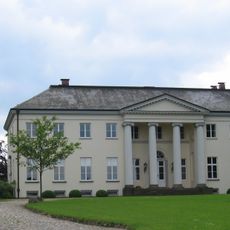
Château de Wedendorf stands on the shore of the Wedendorfer See. Andreas Gottlieb von Bernstorff had a two-and-a-half-storey plastered manor built here in 1697, with two short gabled side wings. From 1805 to 1810 Martin Friedrich Rabe rebuilt it for Ernst Graf Bernstorff: the central block gained a half-storey, the ground floor was rusticated and the facade renewed in neoclassical style, with segmental pediments on the wings.
The estate belonged to the von Bülow family from 1255 to 1680, then passed to the von Bernstorffs. Andreas Gottlieb von Bernstorff had the old fortified house demolished and built a baroque manor in 1697. From 1805 to 1810 Martin Friedrich Rabe rebuilt it in neoclassical style for Ernst Graf Bernstorff; the Bernstorffs sold it in 1931.
The Latin inscription above the main portal, placed there in 1697, reads "Tant vaut l'homme, tant vaut sa terre" and "Ne Villa fundum quaerat, neve Fundus villam", pairing the house with its land. Inside, Pompeian-style wall and ceiling paintings by Giuseppe Anselmo Pellicia survive in thirteen rooms, a taste for antiquity current while Pompeii was being excavated.
The château now operates as a hotel with 40 rooms, a helipad, a Marstall and a jetty on the Wedendorfer See. The gate entrance, Marstall, horse stable and surrounding park are listed monuments alongside the house. The grounds lie directly on the lake shore, opposite the estate's service buildings.
The Latin inscription above the main portal, placed there in 1697, reads "Tant vaut l'homme, tant vaut sa terre" and "Ne Villa fundum quaerat, neve Fundus villam" — the house should not lack the land, nor the land the house. The interior paintings in Pompeian style were made by Giuseppe Anselmo Pellicia, brought from Rome in 1797 by Fritz Graf von Reventlow; 13 of them survive.
The community of curious travelers
AroundUs brings together thousands of curated places, local tips, and hidden gems, enriched daily by 92,828 contributors worldwide.