Chinese Tower, Wooden pagoda in Englischer Garten, Munich, Germany
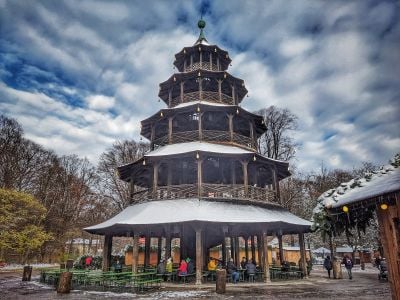
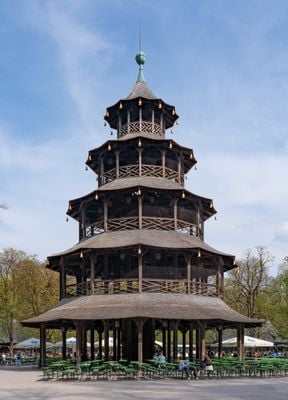
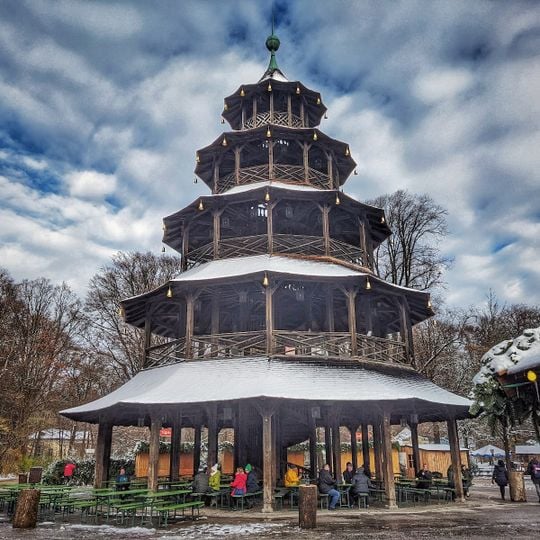
The Chinese Tower is a 25-metre wooden pagoda of five storeys, its polygonal footprint narrowing from about 19 metres at the base to 6 metres at the top. Each level carries a shingled roof and a railed balcony, and gilded bells hang at the inner corners. A spiral staircase links the floors, and the whole stands on posts beneath a wide lower roof.
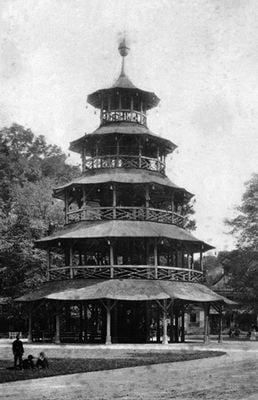
The tower was designed by Johann Baptist Lechner from a proposal by Joseph Frey and built in 1789–1790 by carpenters Johann Baptist Erlacher and Martin Heilmayr, modelled on the Great Pagoda in London's Royal Botanic Gardens. It burned down in a phosphorus bomb attack on 13 July 1944 and was rebuilt in its original form from 1951 to 1952 by architect Franz Zell, reopening on 6 September 1952.
The tower's name comes from the 18th-century European taste for Chinese architecture; its model was the Great Pagoda in London's Royal Botanic Gardens, itself copied from the Majolica Pagoda in Peking. Since 1989 the Kocherlball has been held here on the third Sunday of July, a morning folk dance festival revived from the servants' ball of the 19th century. Brass bands regularly play at the tower.
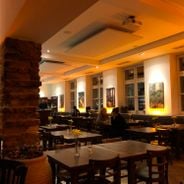
The site is easy to reach on foot and has different seating areas, some with reserved tables and others self-service. The kitchen serves traditional Bavarian food and drinks from morning to evening.
The carousel near the tower, opened in 1913, carries carved wooden deer, ibex, camel, giraffe, horse, stork and flamingo figures in an inner and an outer ring, plus old-fashioned coaches, carriages and sleds, and turns to orchestrion and polyphon music. Since the 1970s only the brass bands that play there may climb the tower.
The community of curious travelers
AroundUs brings together thousands of curated places, local tips, and hidden gems, enriched daily by 92,795 contributors worldwide.