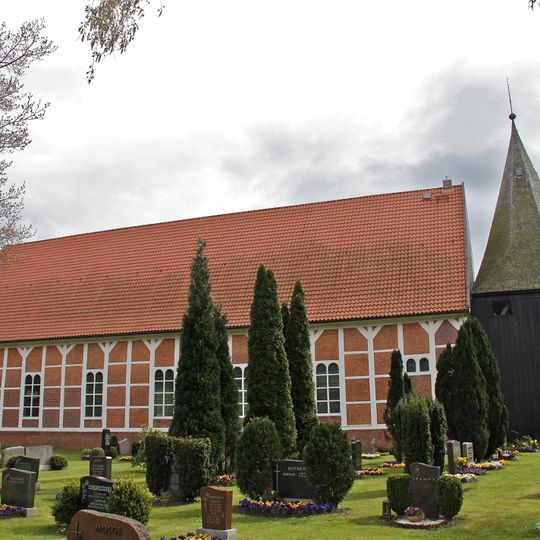
Dreieinigkeitskirche, Baroque church in Allermöhe, Germany
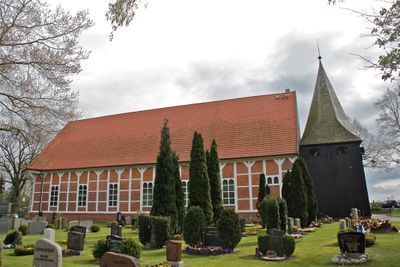
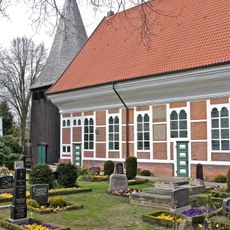
Dreieinigkeitskirche is a single-nave church on the Allermöher Deich, built in 1611–1614 to a design by Simon Lange. Its long walls alternate white plastered piers and bands with red brick infill, and tall arched windows with small panes sit between them. A separate dark timber bell tower with a shingled spire stands at the end, and a five-sided choir closes the nave.
A church in Allermöhe was first documented in 1331, when bells were sold; a building dedicated to the Apostle Peter preceded the present one. The timber bell tower, its oldest parts from before 1580, is the oldest surviving structure in the Marschlande. The brick church by Simon Lange was built 1611–1614 and consecrated on 2 February 1614 by the preacher Albert Wichgreve. Hugo Groothoff led the major restoration of 1900–1901.
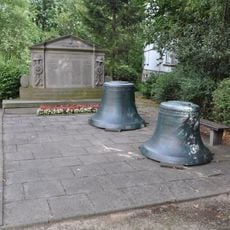
The winged altar carved by Hein Baxmann in 1613/1614 is the only fully preserved piece of the original interior; a figure of the risen Christ was added in 1640. The oldest bell, named Osanna, was cast in 1483 by Cort von der Heyde of Lüneburg and weighs 650 kg. The 1735 Bieber bell was taken for armament in the First World War, returned in 1919 cracked, and was only rehung on 3 September 1994.
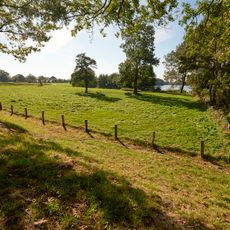
The building is easily accessible from the outside and the surroundings in Allermöhe are quiet with enough space for exploration. Those wishing to look inside should check opening times in advance or attend a service.
The squat timber bell tower is the oldest surviving structure in the Vier- und Marschlande, with its oldest parts dating from before 1580. It hangs the Osanna bell, cast in 1483 by Cort von der Heyde of Lüneburg, weighing 650 kg and bearing a Maria with Christ Child and a Peter on its flanks.
The community of curious travelers
AroundUs brings together thousands of curated places, local tips, and hidden gems, enriched daily by 94,073 contributors worldwide.