Schloss- und Pfarrkirche St. Mariä Himmelfahrt, Castle church and parish in Köthen, Germany
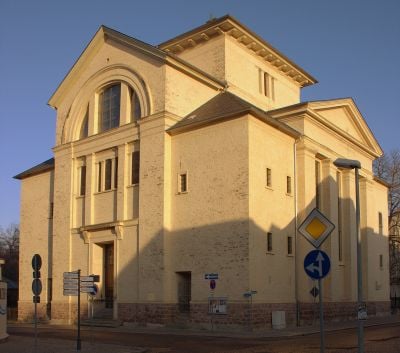
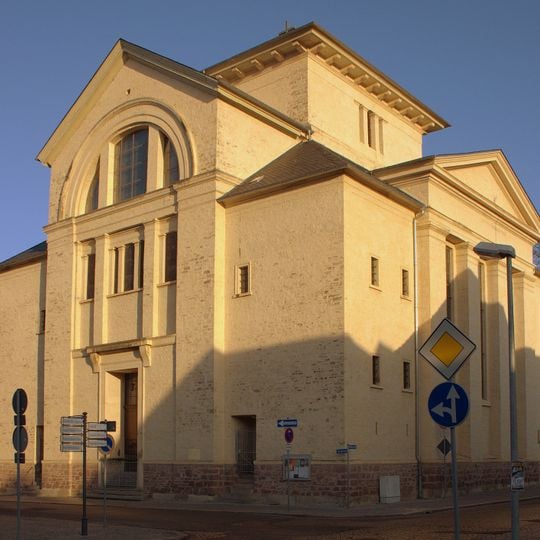
The castle church and parish of St. Mariä Himmelfahrt is a neoclassical building in Köthen with a Greek cross floor plan, high barrel vaults, and slender pillars. Large bright windows in the side aisles flood the interior with light and create its characteristic bright, open appearance.
The building was constructed between 1827 and 1832 under orders from a ducal family and was unusual for its time, as the city was predominantly Protestant. This ambitious project demonstrates how a Catholic family sought to express their presence within a different religious setting.
The name refers to the Assumption of Mary. Duke Ferdinand and his wife Julie, who converted to Catholicism in 1825, are buried in the crypt. The high altar of polychrome Italian marble was donated by Julie; above it hangs a partial copy of Raphael's Madonna of Foligno, given by Pope Leo XII. In 2014/15 Michael Triegel designed the two thermal windows.
The church stands in Köthen (Anhalt) and is reached via its main portal on the west arm of the Greek cross; the entrance is at the projecting portal with steps seen on the facade. The interior is entered from this west side, with the choir and polygonal apse at the opposite east end. The crypt, holding the tombs of Duke Ferdinand and Duchess Julie, lies beneath the church.
The tower was never built: after the scaffolding for the bell tower collapsed in 1830, killing seven workers, the duke abandoned the project. The six bells, cast in 1829, 1966 and 2009, hang in the surviving square tower section. The oldest bears the Latin inscription VENI SANCTE SPIRITUS.
The community of curious travelers
AroundUs brings together thousands of curated places, local tips, and hidden gems, enriched daily by 93,790 contributors worldwide.