Forschungsmuseum Schöningen, Research museum in Schöningen, Germany
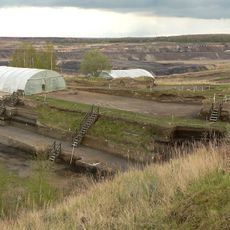
Paläon is a museum and visitor centre at the edge of the former Schöningen open-cast lignite mine in Lower Saxony. Its core exhibit is a vitrine holding the eight Schöningen Spears, about 300,000 years old, preserved with water-soluble synthetic resin. A transparent research and laboratory area and an interactive visitor lab link the exhibition to ongoing Pleistocene archaeology at the site.
The idea of a museum at the find site arose in the late 1990s under mayor Jürgen Lübbe; in 1999 the city hired archaeologist Stephan A. Lütgert as project coordinator. The Zürich office Holzer Kobler Architekturen won the 2010 competition, and the building opened on 24 June 2013 as paläon, named after the Greek palaion ("ancient") for the Palaeolithic. In 2019 it was renamed Forschungs- und Erlebniszentrum Schöninger Speere, and on 1 January 2025 the 3Landesmuseen Braunschweig took over.
The museum shows how early humans lived by displaying their tools and planning abilities. Visitors can see how these people understood and used their surroundings.
The place is easy to explore on foot, with paths leading through the outdoor grounds and connecting to the excavation areas. A visit typically takes a few hours and works well for visitors of all ages.
Wild horses graze in the outdoor area and specific plants grow there, recreating the landscape from a distant past. This reconstruction helps visitors understand how the region looked back then and what animals lived there.
The community of curious travelers
AroundUs brings together thousands of curated places, local tips, and hidden gems, enriched daily by 93,659 contributors worldwide.