Deutsches Buchgewerbehaus, Publishing trade building in Leipzig, Germany
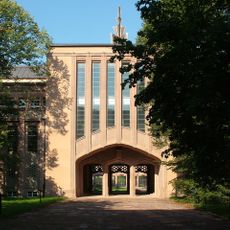
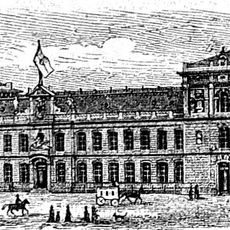
The Deutsches Buchgewerbehaus is a red-brick Neo-Renaissance building in Leipzig's Graphisches Viertel, built 1898–1901 by Swedish architect Emil Hagberg as a counterpart to the Deutsches Buchhändlerhaus. Its centre was the twelve-metre-high Gutenberghalle by Bruno Eelbo, with a three-metre statue of Johannes Gutenberg by Adolf Lehnert. The richly decorated oriel with Gutenberg's portrait and the tiered gable were reconstructed in 2015–2017; the building now serves as housing.
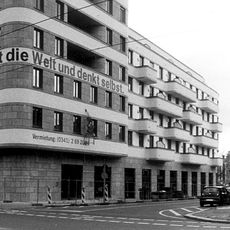
The Deutscher Buchgewerbeverein, founded in 1884 as the umbrella organisation of the graphic industry, first used rooms in the neighbouring Deutsches Buchhändlerhaus. The Swedish architect Emil Hagberg built the association's own Neo-Renaissance house between 1898 and 1901. In 1938 Curt Schiemichen added a northern extension along the Gerichtsweg for the Gutenberg exhibition planned for 1940; after the air raid of 4 December 1943 the building was only simply rebuilt, and between 2015 and 2017 it was comprehensively reconstructed.
The building's name comes from the Deutscher Buchgewerbeverein, founded in 1884 as the umbrella organisation of the German graphic industry. Its centre was the twelve-metre-high Gutenberghalle by Bruno Eelbo, with a three-metre statue of Johannes Gutenberg by Adolf Lehnert, flanked by busts of Alois Senefelder and Friedrich Koenig; Sascha Schneider painted the frescoes. In the cellar of the 1938 extension, the Gutenbergkeller opened and hosted regular jazz concerts from 1965 until its closure in 1991.
The building stands between Gutenbergplatz and Gerichtsweg in Leipzig's Graphisches Viertel, behind the Deutsches Buchhändlerhaus; the former main entrance on the north side faced the abandoned Dolzstraße. It is now a residential building, so visitors should view the red brick facade, the decorated oriel with Gutenberg's portrait and the tiered Neo-Renaissance gable from the street.
The twelve-metre Gutenberg Hall, designed by Bruno Eelbo, was lost in the post-war rebuild; only the windowless oriel that once held Adolf Lehnert's three-metre Gutenberg statue remains readable on the outer wall. The 2015–2017 reconstruction restored around 1,000 running metres of sandstone ornament and 150 reliefs with allegories such as the use of papyrus.
The community of curious travelers
AroundUs brings together thousands of curated places, local tips, and hidden gems, enriched daily by 93,117 contributors worldwide.