Kühlungsborn Windmill, Ground-sailer Dutch smock mill in Kühlungsborn, Germany
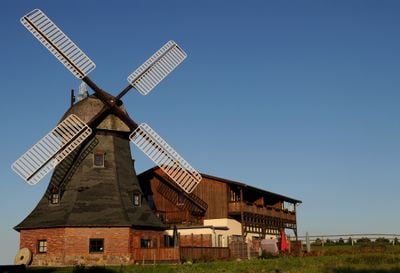
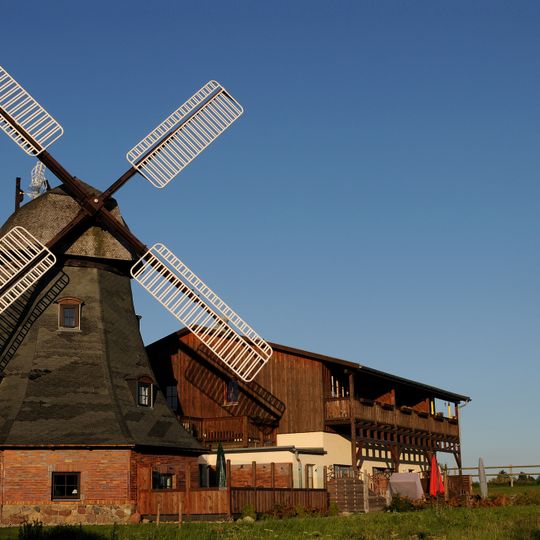
The Kühlungsborn Windmill is an Erdholländer (ground-sail Dutch) smock mill: a conical timber body on a brick base, with a reefing stage at ground level. Its four sails were fitted with a Ventikante and a chain-operated Drehheck in 1936. A wind rose replaced the tail pole around 1900.
A mill in Brunshaupten was first recorded in the Mecklenburg State Calendar in 1791 and called an Erbwindmühle in 1841. Around 1900 it received a wind rose and lost its tail pole; in 1910 miller Haacker bought it for 40,000 marks. Renovations in 1913 and 1936 replaced the sails and added a chain-operated rotating hatch.
The mill's name refers to its type: an Erdholländer, a Dutch-style smock mill built on ground level rather than on a raised mound. The miller's family, the Haackers, ran it until 1961, when they fled to Hamburg; the building then stood empty until its 1987–1991 restoration. Since a 2010–2011 conversion the former mill rooms serve as a holiday flat.
The mill stands in the Kühlungsborn district of Brunshaupten, where it was first recorded in 1791. It has been a holiday flat since the 2010–2011 conversion, so the interior is not open as a museum; the building is viewed from outside. The mill is a listed monument, and the 1936 jalousie sails with vent edge and the chain-operated rotating hatch can be seen on the exterior.
The mill's 1936 refit added a Drehheck, a rotating hatch opened and closed by flyweights on rods and operated from outside with a chain. In 1953 a double roller mill and a centrifugal sifter raised capacity to one tonne of fine flour a day, and a peeling machine allowed barley flakes, groats and grits.
The community of curious travelers
AroundUs brings together thousands of curated places, local tips, and hidden gems, enriched daily by 92,736 contributors worldwide.