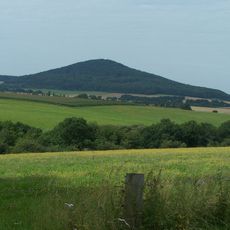
Dietrichsberg, Mountain summit near Vacha, Germany
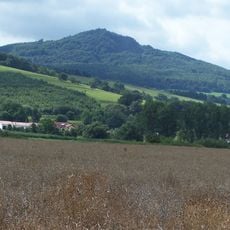
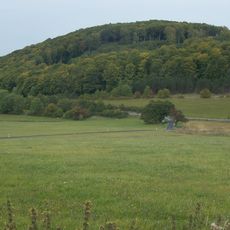
Dietrichsberg is a mountain summit in the Rhön region of Thuringia that rises to about 670 meters. Its slopes are covered by mixed forests and open meadows that create a varied natural landscape.
The mountain formed around 19 million years ago through volcanic activity that shaped the Rhön region. Its basalt deposits later became important for quarrying operations that developed in the 20th century.
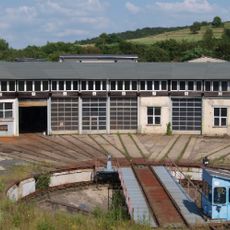
The basalt quarry on the Dietrichsberg was opened in 1924 by Heinrich Hagemeier, former director of the Heiligenmühle potash company in Niederoechsen. He built a basalt works near Masbach and a loading siding on the Wenigentaft-Mansbach–Oechsen railway, linked to the quarry by a cable car. The works became the region's largest employer after the potash mines; the quarry is now run by Rhönbasalt Vacha GmbH.
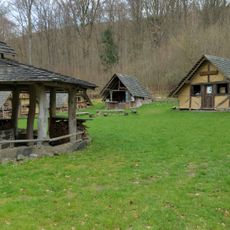
The summit lies within the Thuringian Rhön landscape protection area, and the upper slopes and peak are excluded from the Öchsenberg-Dietrichsberg-Sattelberg FFH area. The quarry on the mountain is operated by Rhönbasalt Vacha GmbH and is not open to visitors. The open-air museum Keltendorf Sünna and the Kelten-Hotel Goldene Aue stand in the small valley west of the transition to the Öchsenberg.
The basalt of Dietrichsberg is a hauyne-bearing basanite, dated by the 39Ar-40Ar method to 19.0 ± 0.1 million years. Like all basalt hills of the Rhön, the mountain is not itself a volcano: it is probably a cryptodome, an intrusive body later exposed as a hard remnant as the surrounding rock eroded away.
The community of curious travelers
AroundUs brings together thousands of curated places, local tips, and hidden gems, enriched daily by 93,847 contributors worldwide.