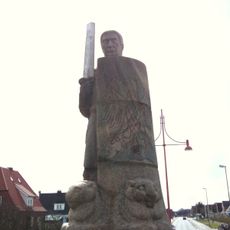
Friedhof der Heimatlosen, Historical cemetery in Westerland, Sylt, Germany.
The Friedhof der Heimatlosen is a small memorial cemetery in Westerland on Sylt, enclosed at the corner of Elisabethstraße and Käpt'n-Christiansen-Straße. It holds 53 graves of unidentified seafarers, each marked by a simple wooden cross bearing the burial date and the name of the beach where the body was found. A memorial stone donated by Queen Elisabeth of Romania in 1888 stands on the grounds.
Strandvogt Wulf Hansen Decker established the cemetery in 1854; before then, unidentified bodies washed ashore were left unattended. The first burial, on 3 October 1855, was a sailor found the previous day on Westerland beach. The last took place on 2 November 1905. In all, 53 unknown seafarers were interred: 23 from Westerland beach and 15 each from Rantum and Hörnum. The cemetery closed in 1907.
The name reflects its purpose: a burial place for people without known identities or families to claim them. Visitors see simple wooden crosses and memorial stones that show how the community has honored and remembered these deceased over many generations.
The cemetery lies at the corner of Elisabethstraße and Käpt'n-Christiansen-Straße, within Westerland's built-up area; the street was named after Queen Elisabeth of Romania during her 1888 stay. The site is a preserved memorial ground, not an active burial place, so there are no graveside services to work around. The last interment took place on 2 November 1905 and the cemetery was closed in 1907.
In 1888, Queen Elisabeth of Romania donated a memorial stone inscribed with verses about those lost at sea, showing the international attention this place drew. The stone stands today as one of the most notable objects on the grounds and reminds visitors of the compassion this site received from distant lands.
The community of curious travelers
AroundUs brings together thousands of curated places, local tips, and hidden gems, enriched daily by 94,633 contributors worldwide.