Hanekenfähr Ems Weir, River weir near Hanekenfähr, Germany
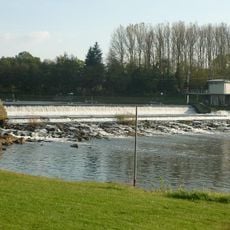
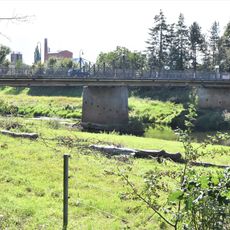
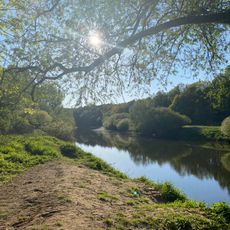
The Hanekenfähr Ems Weir is a four-field water control structure spanning the Ems River between Lingen and Emsbüren. The construction regulates water levels for navigation along connected canals and includes passages designed for fish to move freely.
The first weir at Hanekenfähr was built between 1823 and 1825 as a needle weir of simple oak beams, in preparation for the Ems-Hase Canal, to raise the Ems so that barges with about one metre draught could reach the new canal. In 1876/77 it was replaced by a fixed stone overfall weir for the Ems-Vechte Canal, and at the fishery's insistence it received two fish passes, a salmon ladder and an eel ladder. It was modified and strengthened in 1896 during construction of the Dortmund-Ems Canal.
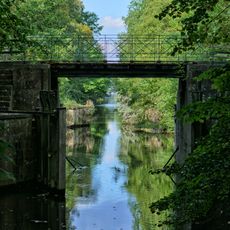
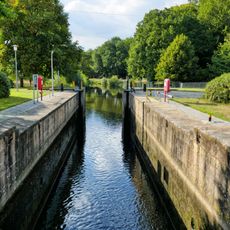
Locals call the weir "Der Wasserfall" (the waterfall), a nickname for the broad stepped overflow where the Ems drops across the structure. The name Hanekenfähr itself points to a former ferry crossing (Fähr) at this spot on the river. A small remnant of the old Ems-Hase Canal with an old lock chamber survives close to the weir.
The weir lies about 8 km south of Lingen, with the north bank in Lingen and the south bank in Elbergen, part of Emsbüren. A short section of the old Ems-Hase canal with an old lock chamber survives near the weir. The structure is managed by the Wasserstraßen- und Schifffahrtsamt Ems-Nordsee.
Proposals for a hydroelectric power station have been discussed here since the 1920s, with modern plans now suggesting water screws as an energy generation method. This potential project could provide renewable electricity while maintaining the weir's water control functions.
The community of curious travelers
AroundUs brings together thousands of curated places, local tips, and hidden gems, enriched daily by 94,418 contributors worldwide.