St. Michael, Catholic church building near Engelbecken, Berlin, Germany
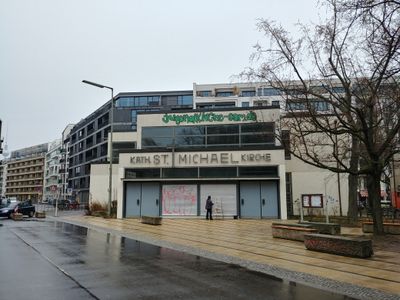
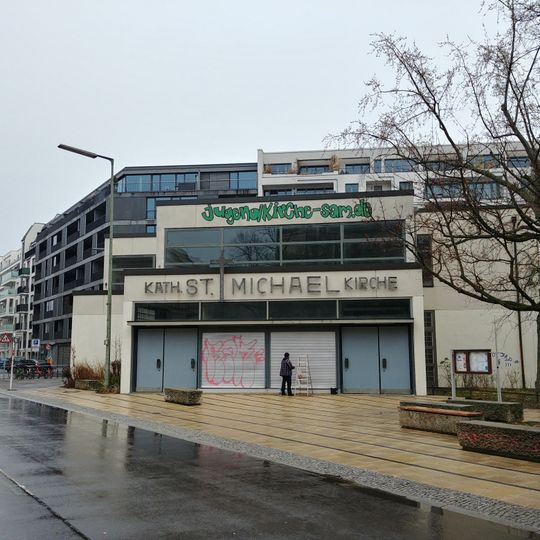
St. Michael is a Catholic church at Waldemarstraße 8–10 in Kreuzberg, designed by Rudolf Schwarz with Hans Schaefers supervising construction. It is built of stacked, height-staggered concrete cubes with a flat roof and no bell tower; the facade bears the carved inscription "KATH. ST. MICHAEL KIRCHE" and a green neon sign reading "JugendKirche - samab". The interior follows the ground plan of an Antonius cross, with the altar island surrounded on three sides by seating.
St. Michael was designed by Rudolf Schwarz with Hans Schaefers supervising construction; the foundation stone was laid on 11 February 1964 and the topping-out ceremony followed on 15 October 1964. The building was blessed on 25 April 1965, after the Berlin Wall had cut the western part of the parish off from its old church. It was blessed rather than consecrated because it was meant to serve as a community hall once the two halves of the parish reunited. The new altar was consecrated at Advent 1989 by Bishop Georg Sterzinsky, weeks after the Wall opened.
Since January 2004 St. Michael has served as the youth church of the Berlin diocese; the green neon sign "JugendKirche - samab" above the entrance marks this role. The name samab stands for the project, and the gallery was converted into a room for conversation. The parish belongs to Bernhard Lichtenberg Berlin-Mitte.
St. Michael stands at Waldemarstraße 8–10, near the former Berlin Wall line; the community bought the plot for its view of the old church across the border. The entrance is a recessed bay with three wide grey double doors, the left one marked by pink graffiti, and two low stone planters sit in front. The building has no bell tower, so look for the green "JugendKirche - samab" neon sign and the carved letters "KATH. ST. MICHAEL KIRCHE" to identify it.
The concrete and modern form of the building feel surprising at first for a Catholic church, showing how religious architecture shifted in the postwar period. This makes it an interesting example of how traditional religious spaces were reimagined through bold new design.
The community of curious travelers
AroundUs brings together thousands of curated places, local tips, and hidden gems, enriched daily by 92,813 contributors worldwide.