St. Blasius, Gothic Revival church in Buchenbach, Germany.
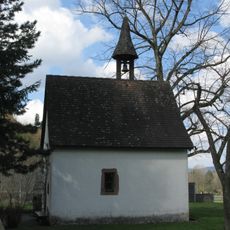
St. Blasius is the Roman Catholic parish church of Buchenbach, built in 1811 by Johann Weber of Bräunlingen and rebuilt in Neo-Gothic form in 1898–1901 to plans by Max Meckel. The white-plastered building has red sandstone corner quoins and window surrounds, a steep red-tiled roof with a cross finial, and a square tower with a clock face and red-tiled spire. Tall arched windows with dark glass line the right facade.
A chapel dedicated to Saint Blaise stood on this site by 1463, tied to the monastery of St. Blasien. The present church was built in 1811 to plans by Johann Weber of Bräunlingen, revised by Friedrich Arnold, and consecrated on 15 November 1811. Max Meckel's Neo-Gothic rebuilding began in 1898 and was consecrated by Archbishop Thomas Nörber on 20 October 1901.
The Blaise patronage stems from the Benedictine monastery of St. Blasien, which held property in Buchenbach after Rudolf of Swabia, rival king to Henry V, granted it during the Investiture Controversy. Saint Anne and Saint Agatha were later added as secondary patrons. The earlier chapel on the site, first mentioned in 1463, could hold 300 people, too few for the 1,220 souls counted in 1786.
The church is accessible via main roads from Buchenbach and located at an easy-to-find spot in the town center. Visitors should note that services and religious ceremonies may affect the timing of a visit.
The 1811 church was built in a single year: the foundation stone was laid on 12 May and the church was consecrated on 15 November. Its first organ came from Freiburg Minster, made in 1708 by Johann Christoph Albrecht; the Pfaffenweiler organ builder Nikolaus Schuble took it in part exchange and moved it to Buchenbach.
The community of curious travelers
AroundUs brings together thousands of curated places, local tips, and hidden gems, enriched daily by 92,704 contributors worldwide.