Wiesneck Castle, Medieval castle in Buchenbach, Germany.
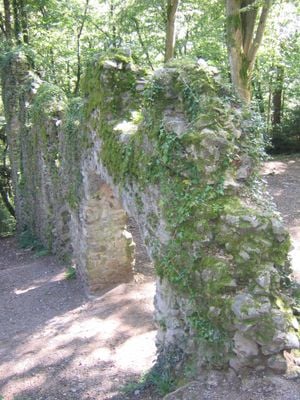
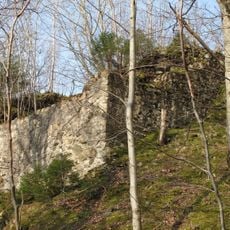
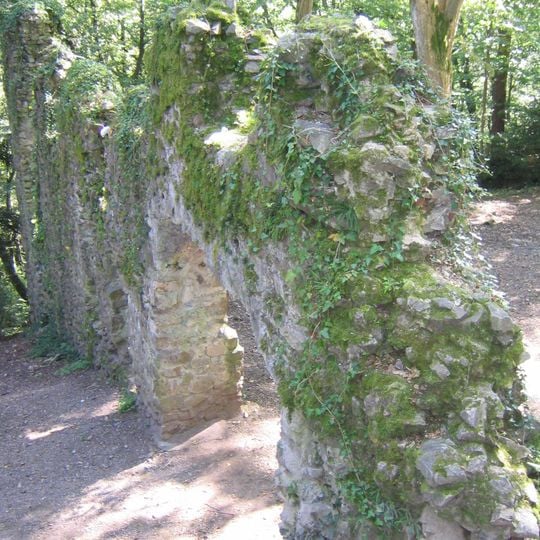
Wiesneck Castle is a ruined hilltop castle at 537 metres above sea level in the Wiesneck district of Buchenbach, in the Southern Black Forest. Of the former outer ward, inner ward and palas only the entrance area and a few wall remains survive, among them a rough rubble-stone wall with a single round-arched opening, heavily overgrown with moss and trailing vines.
The castle was built in 1079 by the counts of Haigerloch and suffered its first destruction in 1121 at the hands of the Zähringens. Following this attack, immediate reconstruction took place, and the site remained occupied for several centuries afterward.
The name Wiesneck passed to the counts of Haigerloch, one of whom, Adalbert, called himself von Haigerloch-Wiesneck from 1096. Bruno of Haigerloch-Wiesneck founded St. Märgen's Abbey in 1118. The village that grew around the castle was incorporated into Buchenbach in 1837.
The ruins are accessible year-round, allowing visitors to explore the preserved entrance areas and wall segments independently. Those planning the ascent should know that reaching the castle site requires walking along a wooded path to the hilltop.
French troops heavily damaged the castle in 1646 during the Thirty Years' War, after which its stones were repurposed over generations for building local farmhouses and cottages. This process of material extraction shaped the appearance of the ruin and tied it closely to the building history of surrounding villages.
The community of curious travelers
AroundUs brings together thousands of curated places, local tips, and hidden gems, enriched daily by 94,118 contributors worldwide.