Glockenberg, Mountain summit in Sankt Andreasberg, Germany.
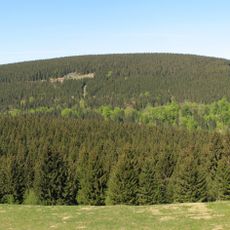
Glockenberg rises to 627 meters above sea level in the Harz region and is surrounded by dense forests and natural rock formations. The mountain features several marked hiking trails that run through the area.
The Glockenturm was first built in 1688 as a simple wooden tower beside the existing Glockenhaus, using usable timber from the dilapidated Dreifaltigkeitskirche. Its position was chosen so that the bells could be heard in both the upper and lower town. In 1834 the tower was rebuilt around the bell frame by Mühlenpfordt, the builder of the Martini-Kirche, giving it its present form. In 1920 three steel bells from the Bochumer Verein replaced the bronze bells melted down for munitions during the First World War.
Every year on Holy Saturday, an Easter fire is lit on the Glockenberg. The mountain takes its name from the bell tower built on it, from which bells have rung for over 300 years; the tower has long been regarded as the landmark of the former free mining town of Sankt Andreasberg.
The summit lies just under 650 metres south-west of Sankt Andreasberg's town hall, framed by the Grüner Hirsch, Wäschegrund and Sperrlutter valleys. The former St. Andreasberg West station of the narrow-gauge railway sits on the north slope, and its 1.6 km cogwheel line to St. Andreasberg Stadt, run from 1913 to 1958, is still used by locals for sledging. A transmission tower stands near the bell tower just north-east of the summit, with the Berghotel Glockenberg on the north-east flank.
From 1913 to 1958, a cogwheel railway called the St. Andreasberger Kleinbahn transported visitors up the mountain slopes. This historic transport system is long shut down but still shapes local memories of earlier mountain travel.
The community of curious travelers
AroundUs brings together thousands of curated places, local tips, and hidden gems, enriched daily by 92,873 contributors worldwide.