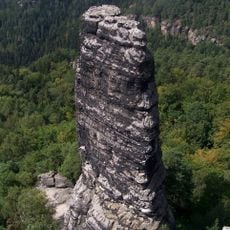
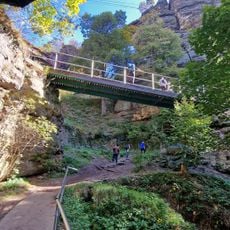
Webergrotte, Natural cave in Sächsische Schweiz-Osterzgebirge, Germany.
Webergrotte is a natural cave set in the sandstone landscape of Sächsische Schweiz, featuring a triangular opening and interior space that rises about 5 meters within the rock. The cave sits along a marked hiking trail through the Großer Zschand valley and can be accessed from the Neumannmühle area.
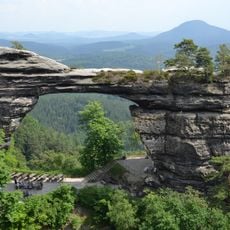
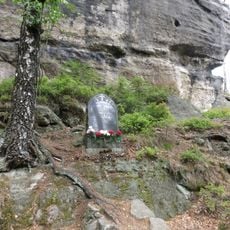
In the early 19th century a trail was cut through the Weberschlüchte past the cave, using steps in a rock block and a wooden ladder to reach the historic Fremdenweg and the Prebischtor. The Brandstein of 1842 recalls the forest fire of 31 August 1842. After the national park was declared in 1990, the ladder was removed and the route to the Prebischtor became impassable.
The cave and the Weberschlüchte gorge are linked by legend to Carl Maria von Weber's opera Der Freischütz, though no evidence supports this. The name Webergrotte and the gorge name Weberschlüchte echo the composer's surname. Visitors today reach the cave on a marked mountain path from the Großer Zschand, since the old route to the Prebischtor was closed.
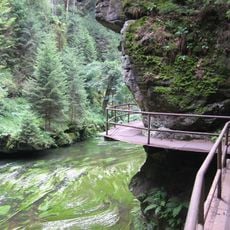
The cave lies at the head of the Weberschlüchte, a roughly 2 km western side gorge of the Großer Zschand, in the core zone of Saxon Switzerland National Park. From Neumannmühle the walk takes about 2 to 2.5 hours. Since the national park path plan took effect, only marked trails may be used in the core zone; the Weberschlüchte is marked as a mountain path from the Großer Zschand onward.
The legend that Carl Maria von Weber drew inspiration for his opera Der Freischütz from the Webergrotte and the Weberschlüchte is not documented. The Brandstein, a stone marker from 1842, stands near the cave and recalls the forest fire of 31 August 1842 in this area.
The community of curious travelers
AroundUs brings together thousands of curated places, local tips, and hidden gems, enriched daily by 93,373 contributors worldwide.