Solingen-Dahl, Historic settlement in Solingen, Germany.
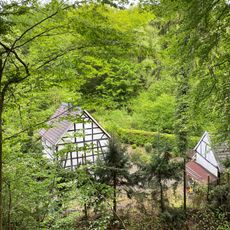
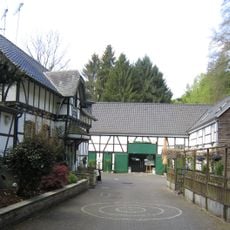
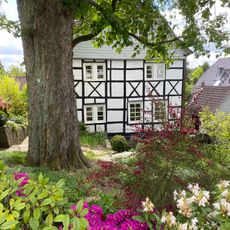
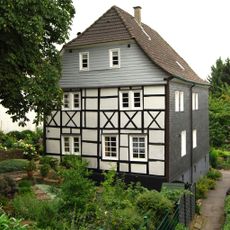
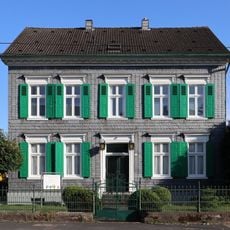
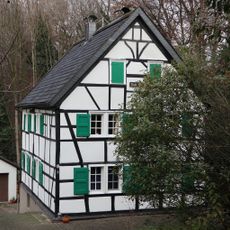
Solingen-Dahl is a hamlet in the Viehbach valley, reached by a cul-de-sac called Kyllmannweg off Merscheider Straße. Its buildings line two small lanes named Dahl. The settlement is dominated by two half-timbered houses from the first half of the 17th century: the Richterhaus, with a natural-stone ground floor and very dense timber framing, and the Schöffenhaus, whose west facade is clad in wooden shingles.
The settlement was first documented in 1363 as Daile and appeared in Abbey Altenberg records by 1488. Over subsequent centuries, it developed into an administrative center where judges carried out their work.
The Richterhaus displays regional architecture through its half-timbered structure and natural stone foundation typical of the period. The settlement served as a residence and workplace for local judges who conducted legal proceedings here.
Dahl lies in the Viehbach valley and is reached by the Kyllmannweg, a cul-de-sac off the Merscheider Straße (L141); the four-lane Viehbachtalstraße passes just to the south. The buildings stand on two small lanes also named Dahl, one of which continues as a footpath into the Viehbachtal and connects to its walking trails. The Peter-Knecht-Haus is a residential building, not a museum.
The name Dahl refers to the site's position in the valley of the Viehbach stream, not to any Slavic root. The settlement was first recorded as Daile in 1363 and as Hove im Daill in the Altenberg Abbey tithe register of 1488, when it was still a single farm.
The community of curious travelers
AroundUs brings together thousands of curated places, local tips, and hidden gems, enriched daily by 93,378 contributors worldwide.