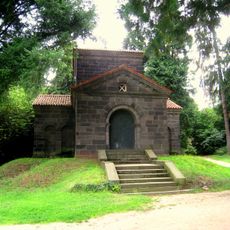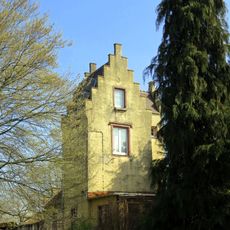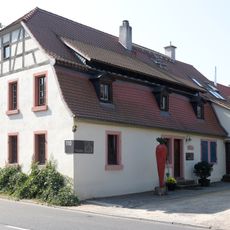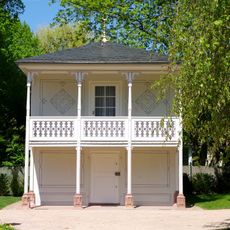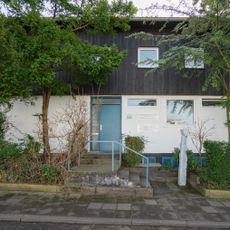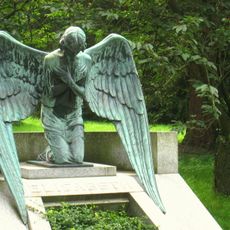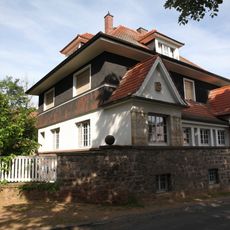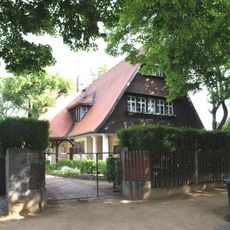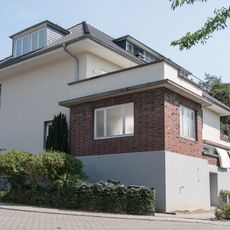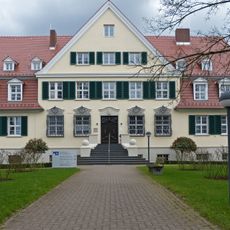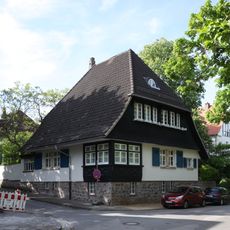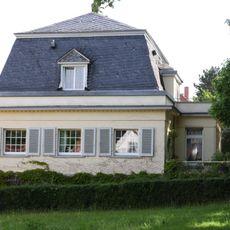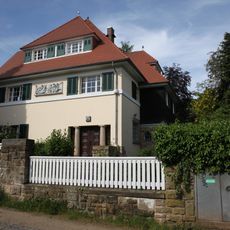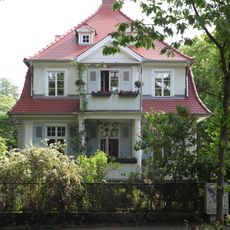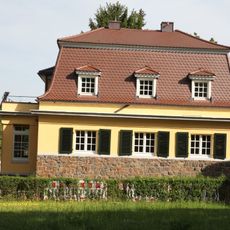
Georg-Christoph-Lichtenberg-Haus, Academic guest house in Darmstadt, Germany.
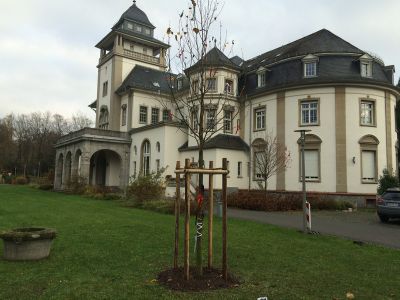
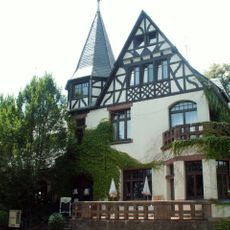
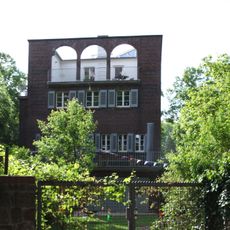
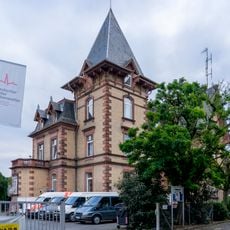
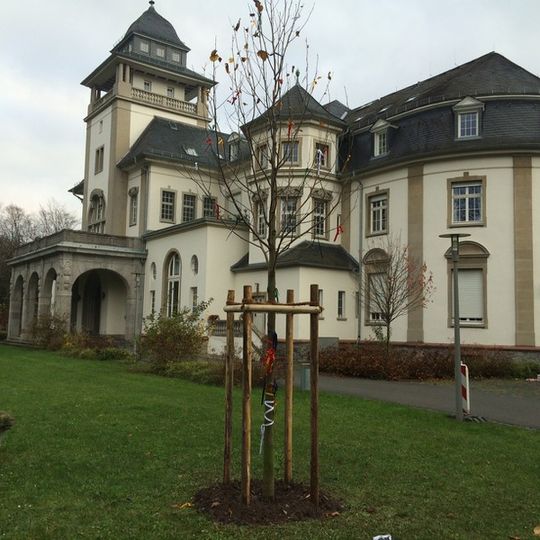
The Georg-Christoph-Lichtenberg-Haus at Dieburger Straße 241 is a two-storey rectangular building with a hipped roof, built in 1899 as the Parkhotel. A five-storey square tower with a slate-covered baroque hood and a surrounding balustrade on the fourth floor is set into the street-side projection. A U-shaped, rounded southwest wing carries a half-hipped roof with triangular-gabled dormers, and an octagonal three-storey tower with a pointed slate hood leans against the west side. The house holds 19 apartments of varying size, with event and community rooms on the ground floor.
Built for Martin Röhrich to plans by architect Fritz Nick, the house opened on 16 October 1899 as the Parkhotel on the edge of Darmstadt. In 1909–1911 Jakob Krug and Georg Scherer rebuilt it as Haus Hagenburg, a residence for Prince Otto Heinrich zu Schaumburg-Lippe and Countess Anna von Hagenburg, adding Jugendstil elements. The Technical University bought the palace in 1955 and has used it since 1980 as a guesthouse for international scholars.
The house is named after Georg Christoph Lichtenberg, the physicist and writer born in 1742 in Ober-Ramstadt near Darmstadt; the name was given in 1983. Since February 1980 it has served as an International Meeting Centre for Science, hosting guest researchers of the TU Darmstadt and the GSI Helmholtz Centre for Heavy Ion Research. The Gotthelf Schlotter animal sculpture "Aufstrebende Kraniche" stands at the fountain in the garden.
The house stands at Dieburger Straße 241 on Darmstadt's eastern edge, with the garden and fountain behind the main building. The 19 apartments vary in size, and the ground floor holds shared event and community rooms. A riding stable on the grounds is used by the TU Darmstadt riding club.
The riding hall on the grounds, about 15 by 20 metres, is covered by a double-shell, self-supporting steel vault from the Art Nouveau period, with a flat inner lining hiding the steel trusses. It survived the Second World War intact and is considered a rare example of a stable complex of that era.
The community of curious travelers
AroundUs brings together thousands of curated places, local tips, and hidden gems, enriched daily by 94,341 contributors worldwide.