Dillsgraben, Natural sinkhole in Königsdahlum, Hildesheim, Germany.
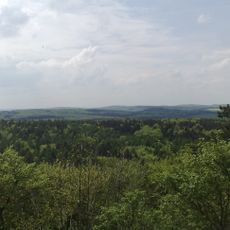
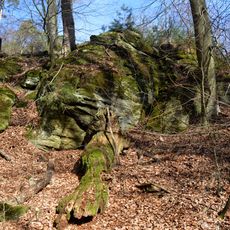
Dillsgraben is a roughly circular collapse funnel, about 140 m across, on the northeast slope of the Harplage ridge near Königsdahlum. Its walls drop about 30 m to a nearly circular lake up to 60 m deep, whose surface at 147 m rises and falls with the groundwater. The flanks carry near-natural broadleaf woodland.
The sinkhole formed about 1000 years ago when underground caves collapsed as water dissolved the rock layers beneath the surface. This process occurred in the gypsum rock beds of the Middle Muschelkalk formation where groundwater erosion weakened the structure.
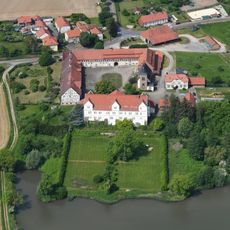
The name Dillsgraben is linked to the Dillssage, the local legend of Ritter Till, which names this spot as the site of a castle; no other evidence of that castle exists. A few metres east-northeast stands the Dillsburg, a villa built around 1888 by Johann Friedrich Weule, founder of the tower clock and bell foundry J. F. Weule. The villa is privately owned.
The site is accessible year-round and offers views of the sinkhole from the surrounding slopes, which provide safe vantage points for observation. During heavy rain the water level rises quickly, so it is helpful to check weather conditions before visiting.
The lake's water level rises and falls with the groundwater table, and the funnel's slopes carry near-natural broadleaf forest. A few metres east-northeast stands the Dillsburg, a villa built around 1888 by Johann Friedrich Weule, founder of the J. F. Weule tower clock factory and bell foundry; it is privately owned.
The community of curious travelers
AroundUs brings together thousands of curated places, local tips, and hidden gems, enriched daily by 93,904 contributors worldwide.