Nikolauskapelle, Chapel and stone house in Ulm, Germany
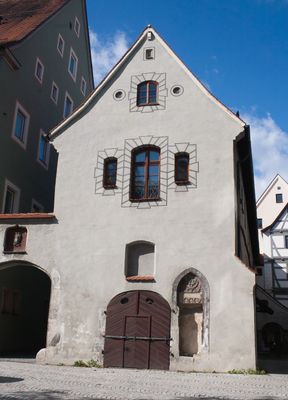
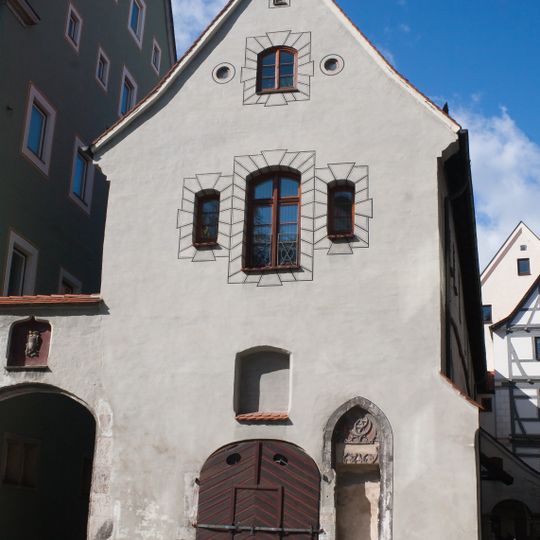
The Nikolauskapelle stands at Neue Straße 102 in Ulm, its pale grey plaster gable pierced by two round openings and a cross-barred window with blue panes, framed by black lines painted as a spiky star. A row of three windows sits below, and a segmented reddish-brown wooden double door opens beneath an empty niche. To the right is an arched stone opening with carved decoration.
An imperial notary named Marquard had the stone house and its attached chapel built in Ulm at the start of the 13th century; in 1222 he gave the property to Salem Abbey, and in 1246 it passed to Reichenau Abbey. Around 1480 the chapel came into the hands of Ochsenhausen Abbey, which rebuilt the Romanesque nave with a ribbed vault and had it reconsecrated in 1499. After Ulm adopted the Reformation, Ochsenhausen bought the confiscated chapel back in 1533 on condition it never be used for worship again.
The chapel's name recalls St Nicholas, and its liturgical use ended in 1533 when the abbot of Ochsenhausen bought it back on condition it never serve the church again. For four centuries it was a shed, coal store and junk room, then a private house. Since the 1978–80 restoration the rooms can be rented for events.
The chapel stands at Neue Straße 102 in Ulm's old town, on the Grüner Hof, a short walk from the Weinhof. Its rooms can be rented for events, so access depends on the booking; the Europa Nostra medal from 1984 is mounted on the north facade.
The Europa Nostra medal awarded in 1984 for the restoration of the Gindele group, comprising the chapel, the Steinhaus and the Gindele building, is mounted on the chapel's northern facade. The chapel had been a ruin since wartime bombing until its restoration in 1978–1980.
The community of curious travelers
AroundUs brings together thousands of curated places, local tips, and hidden gems, enriched daily by 94,387 contributors worldwide.