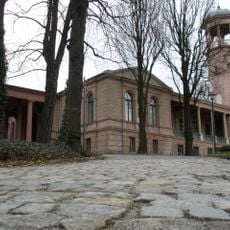
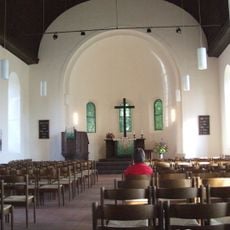
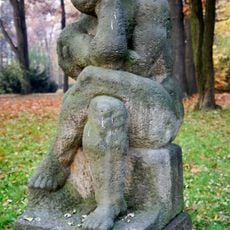
Schlosspark Biesdorf, Garden monument in Marzahn-Hellersdorf, Germany.
Schlosspark Biesdorf is a 14.3-hectare park in Berlin's Marzahn-Hellersdorf district, laid out from 1868 around Biesdorf Palace. Its centrepiece is a cylindrical ice cellar, 3.80 metres in diameter and 7.50 metres high, redesigned around 1900 by architect Paul Hentschel with a double curved staircase of red Main sandstone and twelve stone spheres. A small pond in front supplied the ice, and the excavated earth formed a mound to the north.
The park grew with the 1868 construction of the manor house, after Hans-Hermann von Rüxleben bought seven plots north of the village green. In 1889 Georg Wilhelm von Siemens commissioned garden designer Albert Brodersen to redesign the grounds, and further path changes followed in 1898. Berlin acquired the park in 1927 and opened it to the public a year later.
The grounds host the Kunsthaus Schloss Biesdorf, which presents contemporary art exhibitions, talks, and concerts throughout the year. These events shape the place as a living venue where locals and visitors engage with modern creativity.
The park is accessible via S-Bahn station Biesdorf or U-Bahn station Elsterwerdaer Platz, and opens from 10 AM to 6 PM except on Tuesdays. Visitors should allow time to walk through the different garden areas and dress according to the weather and season.
The park's ice cellar, a cylinder 3.80 metres across and 7.50 metres high, was built into the ground before the villa. Around 1900 Paul Hentschel gave its north side a double curved staircase of red Main sandstone crowned with twelve stone spheres, and a small pond in front supplied the ice that kept food fresh until September or October.
The community of curious travelers
AroundUs brings together thousands of curated places, local tips, and hidden gems, enriched daily by 94,410 contributors worldwide.