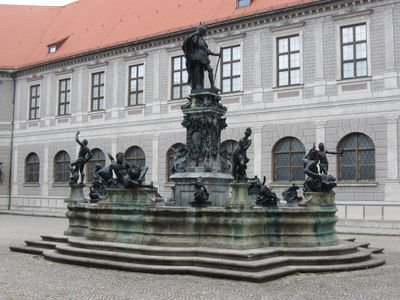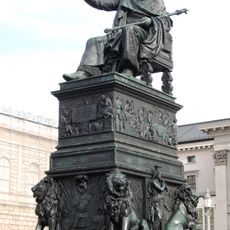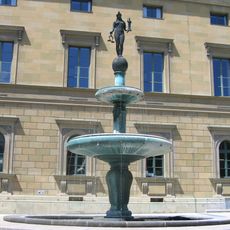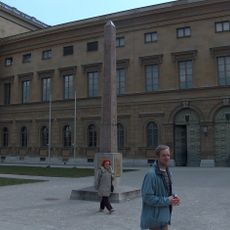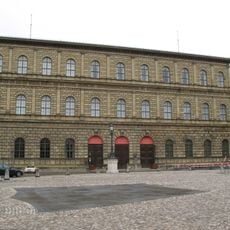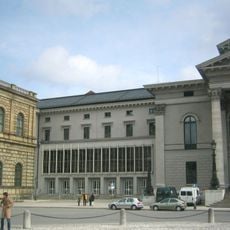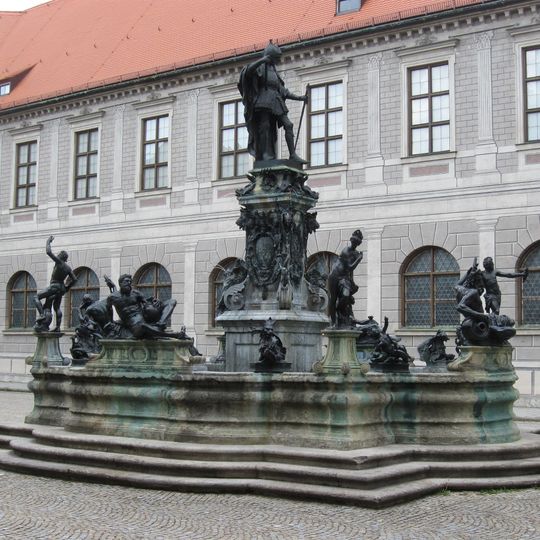
Wittelsbacherbrunnen, Renaissance fountain in the Brunnenhof of Munich Residenz, Bavaria, Germany.
The Wittelsbacherbrunnen is a monumental Renaissance fountain in the Brunnenhof of the Munich Residenz, built 1611–1623 to designs by Hans Krumpper with bronze figures from Hubert Gerhard's workshop. A bronze statue of Duke Otto I of Wittelsbach stands on the central pillar, ringed at the basin rim by four reclining figures personifying the Bavarian rivers Danube, Lech, Isar and Inn, four smaller standing gods, putti and animals.
The fountain was made by Hans Krumpper and Hubert Gerhard in the Renaissance style between 1611 and 1623. Maximilian I acquired it from the estate of his uncle Duke Ferdinand and had it set up in the Brunnenhof in 1611, replacing the original equestrian statue with a bronze of Duke Otto I of Wittelsbach. The main figure had been cast in 1593 for the tomb of Duke Wilhelm V. Damaged in World War II, it was restored from 1953 to 1955.
The fountain's name comes from Duke Otto I of Wittelsbach, whose bronze figure stands on the central pillar; the figure was cast in 1593 for the tomb of Duke Wilhelm V. The four reclining figures at the basin rim personify the Bavarian rivers Danube, Lech, Isar and Inn, while the smaller standing gods Ceres, Vulcan, Neptune and Juno represent the four elements.
The fountain sits within the courtyard and is accessible to visitors during museum hours. Nearby transit stops at Odeonsplatz and Marienplatz provide convenient public transportation access to the palace complex.
The central figure was long mistaken for Duke Theodo of the Agilolfings, so the fountain was wrongly called the Agilolfingerbrunnen. In fact the bronze had been cast in 1593 for the tomb of Duke Wilhelm V, and Maximilian I had it reused here as Otto I of Wittelsbach when the fountain was moved into the Brunnenhof.
The community of curious travelers
AroundUs brings together thousands of curated places, local tips, and hidden gems, enriched daily by 92,789 contributors worldwide.