National Theatre Munich, Opera house in Münchner Altstadt, Germany.
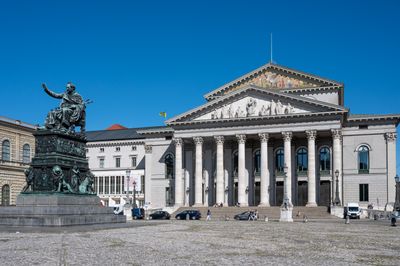
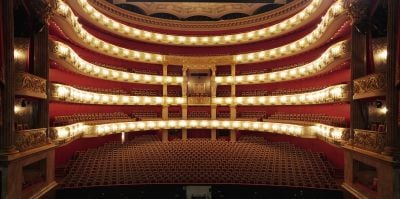
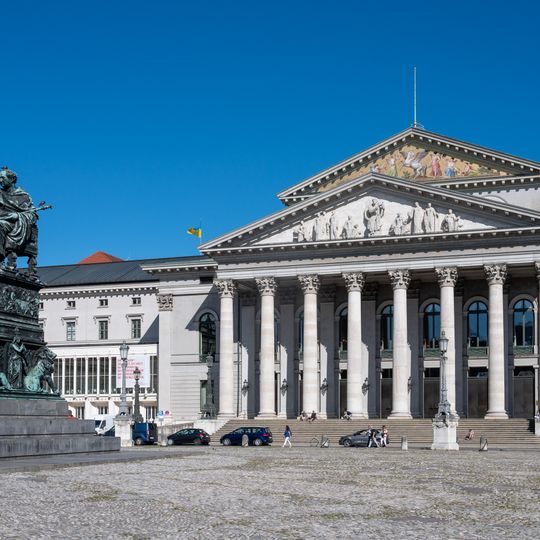
The National Theatre Munich is a neoclassical opera house on Max-Joseph-Platz, built 1811–1818 by Karl von Fischer and rebuilt after 1823 by Leo von Klenze. Its light grey stone facade has a broad staircase, a portico of ten Corinthian columns and a double pediment; the upper mosaic shows Pegasus and the Horen. A bronze equestrian statue stands to the left of the front. The auditorium seats 2,101.
King Maximilian I commissioned Karl von Fischer's theatre in 1810; construction began in 1811 and opened in 1818. After the 1823 fire, Leo von Klenze added the columned portico and double pediment for the 1825 reopening. An air raid on 3 October 1943 gutted the building; Gerhard Moritz Graubner's reconstruction, costing 62 million Deutsche Mark, reopened it in 1963.
The theatre is the venue of the Bavarian State Opera, Bavarian State Orchestra and Bavarian State Ballet. Its stage hosted the premieres of Wagner's Tristan und Isolde (1865), Die Meistersinger von Nürnberg (1868), Das Rheingold (1869) and Die Walküre (1870). Richard Strauss was principal conductor from 1894 to 1898, and his operas Friedenstag (1938) and Capriccio (1942) were first performed here.
The building sits centrally at Max-Joseph-Platz and is easily reached on foot from the Marienplatz U-Bahn station. Visitors should check in advance when tours or performances are happening to plan their visit best.
A recording from this theatre – specifically singer Edda Moser performing an aria from Mozart's The Magic Flute – was included on NASA's Voyager Golden Record sent into space. This disc carries messages from humanity to the stars.
The community of curious travelers
AroundUs brings together thousands of curated places, local tips, and hidden gems, enriched daily by 92,831 contributors worldwide.