Kellertor, Historical city gate at eastern waterfront in Potsdam, Germany.
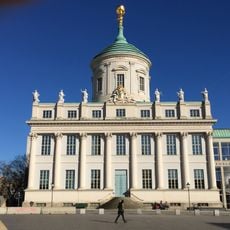
The Kellertor is a classical city gate at the eastern waterfront of Potsdam featuring ten columns in Greek style. It marks an important junction where the city canal meets the former approach to the Berlin Bridge.
A wooden provisional gate preceded the structure King Frederick William II had rebuilt in 1788 with a bridge and canal. The guard and customs house, with late-Baroque decoration, followed shortly after his death, probably to plans by Georg Christian Unger. Soviet artillery hit the gate in World War II, and the surviving portico was demolished around 1960. The plot was sold in 2015 on condition of a scale- and profile-faithful reconstruction, completed in 2017 as housing.
The guardhouse's design likely took after Claude Nicolas Ledoux's 1770/1771 music pavilion for Madame du Barry at Louveciennes near Paris. The gate's name comes from the Kellerstraße, the street leading to the electoral wine cellar, today's Heilig-Geist-Straße.
The gate stood at the eastern entrance to the city, where the Große Fischerstraße meets the start of the Stadtkanal; the rebuilt guard house is now a private residence and cannot be entered. The public Uferpark lies on the Kellertorspitze behind the guard house, on the Havel side at the canal branch. Look for the remains of the 1722 city wall in the Große Fischerstraße to read the gate's position in the old fortifications.
The gate's guardhouse was modelled on the music pavilion of Madame du Barry at Louveciennes near Paris, built by Claude Nicolas Ledoux in 1770/1771. The reconstruction completed in 2017 follows the original scale and profile, and the building now serves as a residence.
The community of curious travelers
AroundUs brings together thousands of curated places, local tips, and hidden gems, enriched daily by 94,647 contributors worldwide.