Schloss Leitzkau, Romanesque castle in Leitzkau, Germany
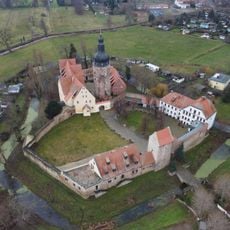
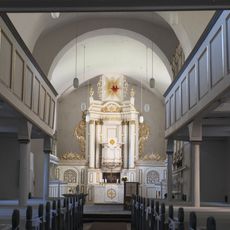
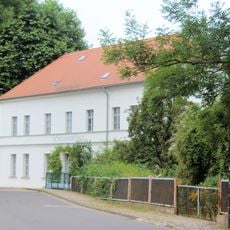
Schloss Leitzkau is a castle and former Premonstratensian monastery complex in Leitzkau, part of Gommern, Saxony-Anhalt. The rectangular complex grew from the medieval convent buildings; the former monastery church became the castle church, its side aisles and choir demolished and its north tower halved. Statius von Münchhausen added the 'Althaus' and from 1593 rebuilt the 'Neuhaus' on the west convent wing's foundations, linked to the late Gothic provost's house by a four-storey loggia facade with stair tower.
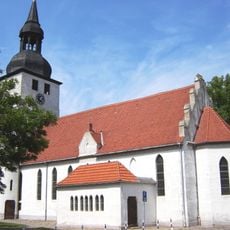
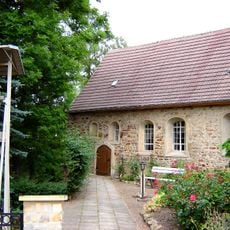
St. Petri in Leitzkau, built from 1107 as a stone church, served as the provisional cathedral of the Brandenburg diocese. In 1133 a Premonstratensian canons' monastery was established; its Romanesque basilica, consecrated in 1155, lost its leading role after Brandenburg Cathedral was restored. The monastery was dissolved in 1535, and in 1564 Hilmar von Münchhausen bought the estate for 70,000 thalers and converted the convent into a castle.
The name Leitzkau recalls the Premonstratensian canons who settled here in 1133; their monastery was dissolved in 1535 during the Reformation. The site now serves as the headquarters of the Kulturstiftung Sachsen-Anhalt, the cultural foundation of Saxony-Anhalt. Nine manuscripts from the medieval Leitzkau monastery, dating from the 12th and 13th centuries, are kept today in the Herzog August Bibliothek in Wolfenbüttel and in the Anhaltische Landesbücherei in Dessau.
The complex lies in the Leitzkau district of Gommern, in the Jerichower Land district of Saxony-Anhalt. The castle and the former monastery church are listed as a monument under registration number 094 41165. The site belongs to the Kulturstiftung Sachsen-Anhalt, which has its main office there, so parts of the buildings serve as offices rather than as museum rooms.
The village church of St. Petri, begun in 1107, is probably the oldest surviving stone church east of the Elbe, though much altered. The monastery church "Sancta Maria in Monte", consecrated in 1155, stands nearby as a restored ruin: its roof was re-covered, nave and transept reopened, the south aisle rebuilt, and one west tower cut down to a stump.
The community of curious travelers
AroundUs brings together thousands of curated places, local tips, and hidden gems, enriched daily by 92,786 contributors worldwide.