Bohlen, National geological outcrop in Saalfeld, Germany
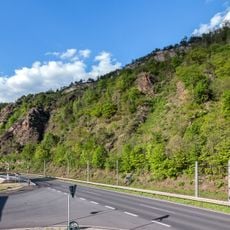
The Bohlen is a rock face that extends about 800 meters in length and around 100 meters in height. It rises along the Saale Valley between the settlements of Köditz and Obernitz and displays multiple rock layers from different geological periods.
This location was first scientifically documented in 1761 by Georg Christian Füchsel, establishing the study of this rock formation. Major fossil discoveries made here during the 19th century grew attention to the site and its geological importance.
The reddish Upper Devonian nodular limestones and slate were quarried as building stone in the Obernitz Plattenbruch until the Second World War; in 1938 alone 1,100 cubic metres were extracted. The finer material was later processed and sold as Fischerdorf marble by the Saalburg marble works. At the northwest end the mouth of the Gottlob adit survives, a relic of mining attempts on the black and alum shales.
The rock face is accessible directly from the B85 federal highway that passes between Köditz and Obernitz. Access is straightforward, allowing visitors to observe the different rock layers up close.
Fossils such as Goniatites, Clymenia, and Trilobites are found at this rock face and were first documented here scientifically. These finds helped researchers better understand how these creatures lived in earlier geological times.
The community of curious travelers
AroundUs brings together thousands of curated places, local tips, and hidden gems, enriched daily by 92,681 contributors worldwide.