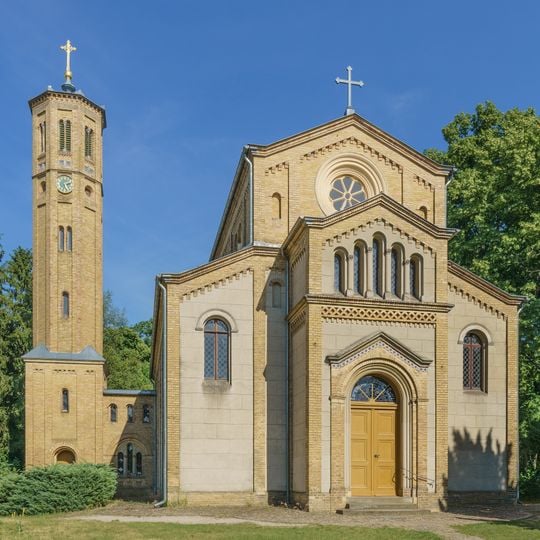
Village church Caputh, Romanesque Revival church in Caputh, Germany.
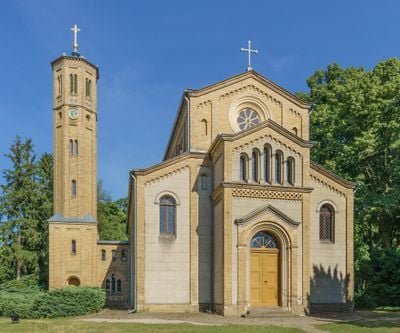
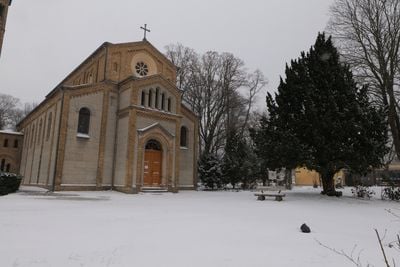
The Village Church Caputh is a pillared basilica built of light tan brick and stone in the Rundbogenstil, designed by Friedrich August Stüler and erected 1850–1852 under Christian Heinrich Ziller. A tall square clock tower with a gold cross stands north of the nave, linked by a small sacristy. The west facade has a projecting portal with a yellow double door, a rose window above, and a gable with five narrow arched windows.
Caputh was first documented in 1317, and a church may have existed there since the 14th century, though this is unproven. The Dehio handbook suggests that parts of the long walls from a building of around 1600 were reused. A structure of 1820 had become dilapidated, so the parish commissioned a new church, built 1850–1852 by Christian Heinrich Ziller to a design by Friedrich August Stüler. The roof and the nave's coffered ceiling were renewed in 1914, with restorations in 1981–1988 and 1999–2000.
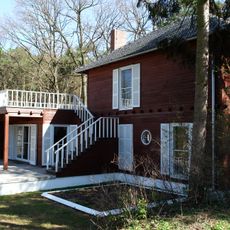
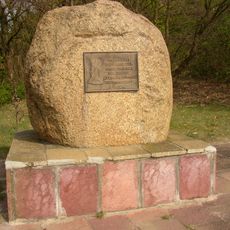
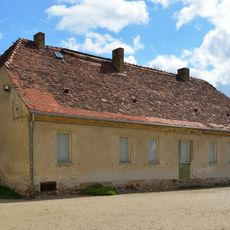
The churchyard holds a Luther oak grown from an acorn of the Wittenberg Luther oak, and a few metres east the Haken-Stein boulder commemorates the Caputh doctor Oskar Haken, who took his own life in April 1945 before the Red Army arrived. A former hearse shed from before 1945 stands at the northern edge.
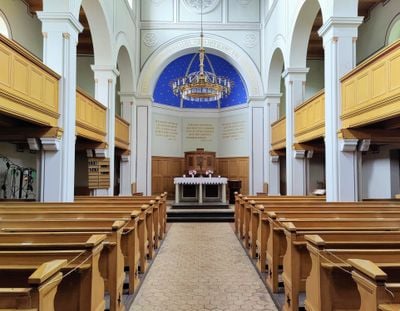
The church is located at Straße der Einheit 1 in Caputh and welcomes visitors. Regular services take place on Sundays, which offer chances to see the interior and experience the building firsthand.
In the churchyard east of the building, toward Seestraße, grows a Luther oak raised from an acorn taken from the Luther oak in Wittenberg. A few metres further east stands the Haken-Stein, a boulder commemorating the Caputh doctor Oskar Haken, who took his own life in April 1945 before the Red Army arrived.
The community of curious travelers
AroundUs brings together thousands of curated places, local tips, and hidden gems, enriched daily by 94,367 contributors worldwide.