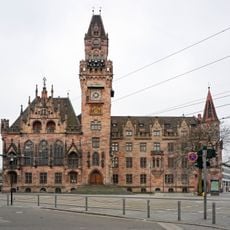
Wartburg, Art Deco event building in St. Johann, Saarbrücken, Germany
Wartburg is a building at Martin-Luther-Straße 12 in the St. Johann district of Saarbrücken, erected from 1927 to 1928 as a parish hall for the Protestant congregation. Its Art Deco design by architect Rudolf Seifert features geometric decorative forms, especially on the rear stage house of the theatre hall with its vertical and horizontal straight profiles. The large festival hall held 1,500 to 1,700 people and was for many years the largest event hall in the Saarland.
Built from 1927 to 1928 as a parish hall for the Protestant congregation of St. Johann, the Wartburg was designed by architect Rudolf Seifert in Art Deco style and inaugurated in 1928. In the nights of 13 to 15 January 1935 its hall served as the central counting site for the Saar plebiscite, and the Swedish commission president Rodhe announced the result there. From 1935 to 1944 the Reichssender Saarbrücken used the building, and from 1946 it housed Radio Saarbrücken, from which today's Saarländischer Rundfunk emerged.
The name refers to the Wartburg near Eisenach, where Martin Luther stayed after the imperial ban; pastor Wilhelm Reichard called the building a "stone expression of defiant strength." A plaque in the foyer, removed by the French occupation in 1945 and rehung after 1955, commemorates the 1935 Saar plebiscite count held here.
The building stands at Martin-Luther-Straße 12 in St. Johann, running north-south between that street and the Hessenweg; the street was called Nauwieser Straße until 1951. It is not a protected monument, and after 1945 repeated conversions for practical needs removed nearly all stylistic features and many traces of earlier use. The foyer keeps a memorial plaque to the 1935 Saar vote, removed by the French occupation authority in 1945 and rehung after 1955.
A plaque in the foyer records that the night of 14 to 15 January 1935 the votes of the Saar plebiscite were counted in the hall; the Swedish commission president Rodhe announced the result there at dawn. The plaque was removed by the French occupation authorities in 1945 and rehung after 1955.
The community of curious travelers
AroundUs brings together thousands of curated places, local tips, and hidden gems, enriched daily by 92,894 contributors worldwide.