Rittergutspark Destedt, protected landscape in Lower Saxony, Germany
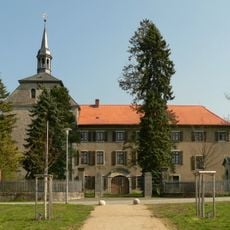
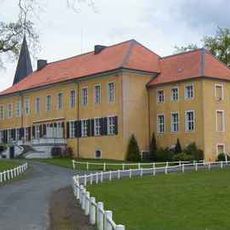
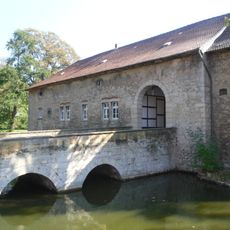
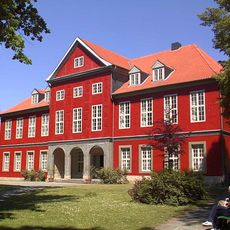
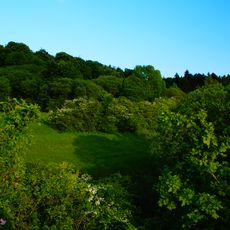
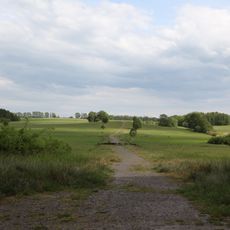
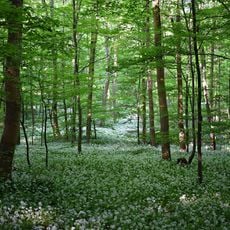
Rittergutspark Destedt is a 6.2-hectare landscape conservation area beside Schloss Destedt on the edge of Destedt in Lower Saxony. It lies east-west in front of the castle's north facade, entered over the Chinesische Brücke at a pond with a fountain. Winding named paths pass stone ruins, grottoes and a sandstone urn, and many trees exceed 40 metres.
Johann Friedrich von Veltheim (1731–1800) began reshaping the small French-style garden at Destedt in 1768, after his marriage to Margarethe von Münchhausen of Schwöbber; the gardener Lenke from Schwöbber took a leading part. A plan of 1772 shows a systematic design, making it one of Germany's earliest landscape parks. Land east of the castle was bought until 1793, and seedlings and seeds were imported from overseas.
The park takes its name from its role as an estate property of the Veltheim family, who designed it as a private retreat. Today visitors use the paths and meadows for walks and relaxation, preserving the site's original purpose as a place for rest.
The park lies in front of the north facade of Schloss Destedt and is entered over the Chinesische Brücke, a bridge at a pond with a fountain. Paths are winding and marked with waystones of Elm limestone; numbered trees correspond to a tree guide sold at the estate office. The Palmenhaus, formerly the orangery, is used for celebrations and weddings.
Of the 150 trees listed in the estate's tree guide, about half are of American origin, and numbered tags on the trunks match the guide, sold for a small fee at the estate office. The park holds the only flowering three-lobed pawpaw north of the Alps and one of the largest ginkgos in the Braunschweig region.
The community of curious travelers
AroundUs brings together thousands of curated places, local tips, and hidden gems, enriched daily by 92,713 contributors worldwide.