Rostock New Cemetery, Architectural heritage cemetery in Rostock, Germany
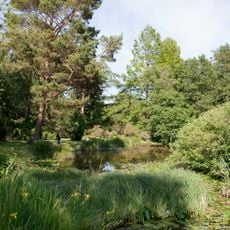
Rostock New Cemetery is a 44-hectare municipal park cemetery opened in 1912 at the southwestern edge of Rostock, in the Gartenstadt/Stadtweide district. Its main entrance is on Satower Straße, which forms the northern boundary; Damerower Weg and Klein Schwaßer Weg bound it to the east and west. The rectangular ground plan has a chapel at its centre where the main and cross axes meet, with an administration building and a caretaker's house flanking the entrance.
In 1905 the Rostock council appointed a cemetery commission after the population rose from 18,067 in 1830 to 54,580 in 1901. A site on the Damerower Feldmark owned by the Hospital zum Heiligen Geist was chosen; city architect Paul Ehmig and city gardener Wilhelm Schomburg planned it, and construction ran from 1908 to spring 1912. The cemetery opened on 1 April 1912, with total costs of about half a million marks; it was first extended in 1943.
The cemetery opened on 1 April 1912 as a non-denominational burial ground, handed over in the presence of a huge crowd. The iron gates at the main entrance were forged by Rostock court locksmith Heinrich Kehr, who received a gold medal at the 1911 Mecklenburg State Trade and Industry Exhibition in Schwerin.
The main entrance is on Satower Straße (L10) at the northern edge; Damerower Weg bounds the cemetery to the east and Klein Schwaßer Weg to the west. The grounds cover 44 hectares, so allow time to cross them. The main and cross axes meet at the chapel in the centre, which helps with orientation.
Local stonemasons and architects created specialized monuments throughout the grounds that show the region's craftsmanship. These graves remain examples of the technical skill practiced by local artisans during the early 20th century.
The community of curious travelers
AroundUs brings together thousands of curated places, local tips, and hidden gems, enriched daily by 94,262 contributors worldwide.