Roland, Heritage monument in Wedel, Germany
The Wedeler Roland is a 4.50-metre-high, 1.50-metre-wide statue of a bearded nobleman wearing a crown and a Gothic plate armour, holding a sword against his right shoulder and an imperial orb in his left hand. It stands on a 2.20-metre brick base with a sandstone foot and capital, facing south toward the Elbe.
A first sign of Wedel's market rights, probably a market cross, was set up around 1450 by the Count of Holstein-Schaumburg. After it decayed, the sandstone statue was erected in 1558, as a receipt for stone from the Obernkirchen quarry shows. It was repaired in 1602, re-erected in 1652 with 100 Reichstaler from the Danish king, and restored again in 1785, 1835–36, 1907 and 2012.
This figure represents the market rights and privileges of the medieval town, serving as the central symbol in Wedel's coat of arms, municipal flag, and official seal. You can see how this monument shapes the town's identity and appears in many public symbols.
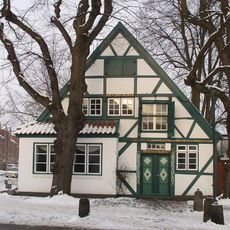
The statue stands on the market square beside the Immanuelkirche, the old parsonage and the former schoolhouse that now houses the town museum. It was moved here in 1950 when the Bundesstraße 431 was widened across the square, so it no longer marks its original spot. Look for the round relief on the back of the brick base reading "Gruss und Segen unseren Nachkommen 1856".
The sandstone relief on the front of the base shows a double-headed eagle, eight-pointed stars and three cylinders; it may be a coat of arms of the House of Schauenburg, but it bears a heart where the nettle leaf would be. The rear relief reads "Gruss und Segen unseren Nachkommen 1856".
The community of curious travelers
AroundUs brings together thousands of curated places, local tips, and hidden gems, enriched daily by 93,485 contributors worldwide.