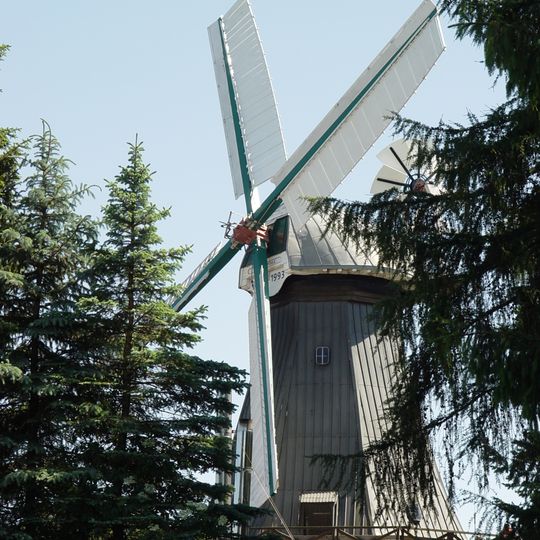
Braaker Mühle, Heritage windmill in Braak, Germany
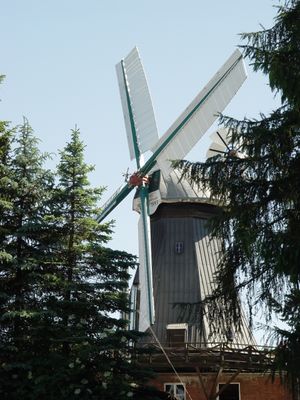
Braaker Mühle is a heritage windmill in Braak, Germany, that has been working with its wooden grinding mechanisms on several floors since the 19th century. The construction follows the Galerieholländer type with a rotating cap and an external gallery around the main body.
Friedrich August Reimers, a miller's journeyman and carpenter from Papendorf, applied for a mill licence on 5 May 1849 and began building on the Röthberg in September 1849, before permission was granted. The permit for one flour and one barley grinding pass came on 30 April 1850 after intervention by minister Boysen in Copenhagen. Reimers went bankrupt in 1859; the mill was auctioned on 10 June 1859 for 9,375 Reichstaler to the miller Carl Heinrich Christoph Lessau.
The mill's name comes from the village of Braak, and a bakery belonging to the mill still uses flour ground there by wind. The miller's room on the sack floor serves as a wedding chamber, and the brick base holds a small shop and a mill café. The sails were replaced in 1996 with a steel frame and aluminium shutters.
The mill is a Galerieholländer: the sails can only be reached via the surrounding gallery, not from the ground. Inside, the brick base holds a small shop and the mill café, with the miller's room above used as a wedding chamber. The octagonal body rises through five floors, from the grinding floor with its two millstones up to the cap floor.
The cap, weighing 13 tonnes, is turned automatically by a wind rose: an eight-bladed wheel 3.5 m across that engages only when the wind strikes from the side, driving a gear with a ratio of 1 to 2633. The sails, mounted in 1996, span 22 m tip to tip.
The community of curious travelers
AroundUs brings together thousands of curated places, local tips, and hidden gems, enriched daily by 92,699 contributors worldwide.