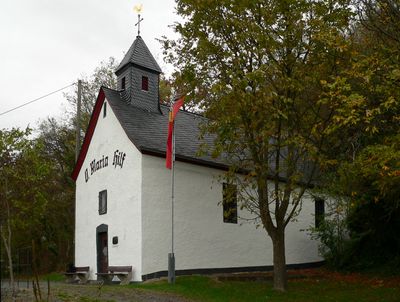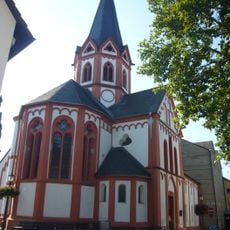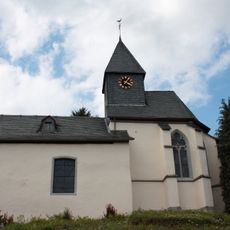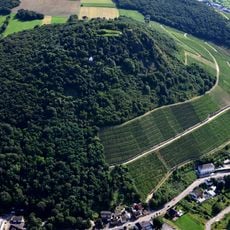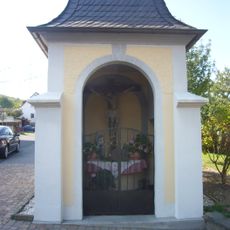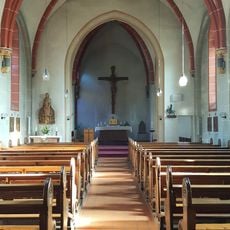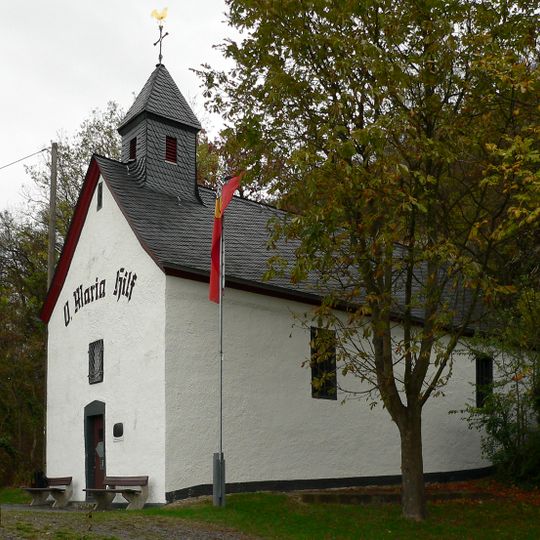
Maria-Hilf-Kapelle, Religious monument in Lohrsdorf, Bad Neuenahr-Ahrweiler, Germany.
The Maria-Hilf-Kapelle in Lohrsdorf is a small church building featuring a stone facade and decorative windows. It displays the characteristic architectural style of religious structures found throughout Rhineland-Palatinate.
The chapel was first documented in 1212, when Emperor Otto IV issued a protection letter exempting it from dues during a visit to Landskron Castle. Its core is Romanesque; it was built, according to legend, by a lord of the castle built in 1206 after his three daughters were rescued from robber knights. Around 1366 a hermit's cell is mentioned, possibly housed in the rock grotto behind the altar. The Fördererverein from Heppingen restored it in 2010.
The chapel is an important gathering place for the local community where residents come to pray and reflect. The name Maria-Hilf reflects the veneration of Mary, which has deep roots in this region.
The chapel can be reached by pathways leading from Bad Neuenahr-Ahrweiler's main areas, with parking spaces located near the entrance. The grounds are accessible and visiting is generally possible throughout the day.
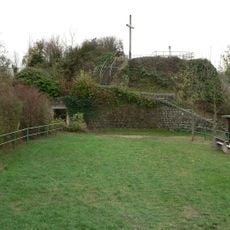
The chapel is also called "Drei Jungfern" and, after a mention around 1470 as "der fünff Jungfern Capell", "Fünf Jungfern". Legend says a lord of Landskron castle built it after his three daughters were rescued from robber knights. Behind the altar, a small grotto is cut into the basalt rock; around 1366 a hermit's cell is recorded, whose occupant may have lived there.
The community of curious travelers
AroundUs brings together thousands of curated places, local tips, and hidden gems, enriched daily by 94,335 contributors worldwide.