Kelle-Teufelskanzel, Nature reserve in Bornhagen and Lindewerra, Germany
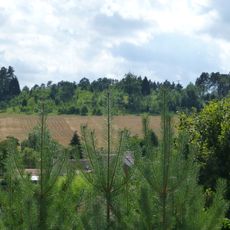
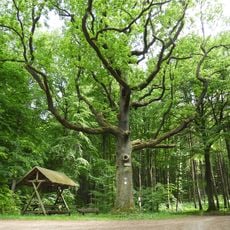
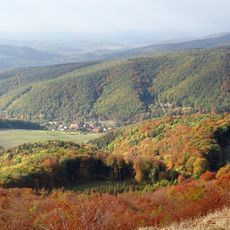
Kelle-Teufelskanzel is a nature reserve on the steep western slope of the Höheberg, where the Kelle valley drops about 365 metres over just 1,400 metres to the Werra. The Teufelskanzel is a roughly 25-metre-high cliff of Middle Buntsandstein sandstone at about 452 metres elevation. The reserve protects coppice-derived forests and borders the Hessian Harthberg reserve.
The reserve was designated in 1996 to protect the forest communities that grew out of former coppice management. It lies on the steep western slope of the Höheberg, a Buntsandstein block uplifted at the transition between the Eichenberg-Saalfeld fault zone and the Leinegraben. It forms part of the Green Belt biotope network and of Natura 2000, and borders the Hessian reserve Harthberg directly to the west.
This protected area is part of the Green Belt, linking ecological corridors along the former inner German border through Thuringia. For visitors, this role remains visible today as a reminder of how nature has recovered across a once-divided landscape.
Trails climb from the Werra valley near Lindewerra up to the Teufelskanzel at about 452 m, gaining roughly 365 m over only 1400 m, with gradients of 18° to 36°. The rock is Middle Buntsandstein, not limestone, so expect slippery sandstone slabs and roots. Sturdy footwear is needed; the Kelle valley stream disappears temporarily in its middle course.
The cliffs are made of Middle Buntsandstein, a red-brown to grey-brown sandstone, not limestone. Local folklore linked the rock to Odin and his Valkyries before it became known as the devil's pulpit; Ludwig Bechstein retold the devil legend in his 1853 German legend book. Theodor Storm, a judge in Heiligenstadt from 1856 to 1864, visited the viewpoint and praised it in his 1867 novella "Eine Malerarbeit".
The community of curious travelers
AroundUs brings together thousands of curated places, local tips, and hidden gems, enriched daily by 94,543 contributors worldwide.