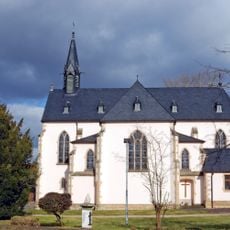
Evangelische Stadtkirche, Protestant church in Wanfried, Germany.
The Evangelische Stadtkirche is a neo-Gothic hall church built in 1884–1888 to designs by Johann Adam Hermann Rüppel, a pupil of the Wanfried-born architect Georg Gottlob Ungewitter. Its layout and furnishings follow the Eisenacher Regulativ of 1861, the Protestant church-building code of the time. The exterior is of local natural stone with pointed-arch windows and a steep roof; inside, three aisles open into one hall beneath a single roof.
The neo-Gothic church was built from 1884 to 1888 to replace the St.-Veits-Kirche, a wooden chapel from around the 8th century that stood for about 800 years. The state architect Mathei from Eschwege had recommended a new building for economic reasons. Karl Xaver von Scharfenberg drove the project, and Johann Adam Hermann Rüppel, a student of Wanfried-born architect Georg Gottlob Ungewitter, served as chief architect. The construction cost 186,000 gold marks.
The church keeps the name Stadtkirche from its predecessor, the St.-Veits-Kirche, a wooden chapel said to have stood for some 800 years before demolition; the town's Protestant congregation still gathers here for services. The 1888 Peternell organ accompanies worship, and the interior follows the Eisenacher Regulativ of 1861.
The church is located at Kirchstrasse 5 and is easily accessible on foot. Opening hours vary by season, so it is helpful to check current times before planning a visit.
The organ was built in 1888 by the Peternell brothers and still sounds during services today. This instrument demonstrates the craftsmanship of the late 1800s.
The community of curious travelers
AroundUs brings together thousands of curated places, local tips, and hidden gems, enriched daily by 93,136 contributors worldwide.