Basaltkrater Blauer Stein, Natural monument and former quarry in Windeck, Germany.
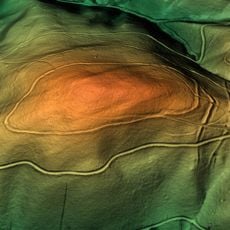
Basaltkrater Blauer Stein is a former quarry west of Kuchhausen, a district of Windeck in the Rhein-Sieg-Kreis. The basalt deposit lies on an oval area about 100 metres long, where magma solidified in a funnel-shaped vent into angular columns. The Linzer Basalt AG extracted the rock as building material until the 1920s.
In the Miocene, magma rose through a funnel-shaped vent at Kuchhausen and solidified into angular basalt columns, an isolated offshoot of Westerwald volcanism. The Linzer Basalt AG quarried the basalt as building material until the 1920s. After the quarry closed, the Bürger- und Verschönerungsverein Leuscheider Land turned the site into an excursion destination in the 1970s, and in 1986 it was designated a protected landscape element.
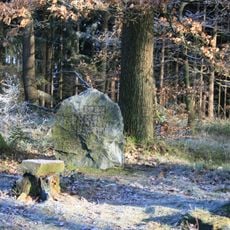
The Bürger- und Verschönerungsverein Leuscheider Land, a local citizens' and beautification association, turned the abandoned quarry into an excursion destination in the 1970s. In 1986 the site was designated a protected landscape element (Geschützter Landschaftsbestandteil). The name "Blauer Stein" refers to the bluish tint of the basalt.
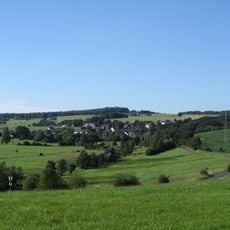
The site lies west of the Kuchhausen hamlet in the municipality of Windeck, in the Rhein-Sieg-Kreis district. It is a former quarry pit, so expect uneven ground and basalt blocks rather than paved paths; sturdy shoes help. The crater was designated a protected landscape element in 1986, so collecting rock or damaging the columns is not allowed.
The Kuchhausen basalt lies on an oval area about 100 metres long and is regarded as an isolated outlier of Westerwald volcanism. Unlike the closed basalt sheets elsewhere in the Westerwald, the magma here never reached the surface but solidified inside the vent. The Linzer Basalt AG quarried the stone until the 1920s.
The community of curious travelers
AroundUs brings together thousands of curated places, local tips, and hidden gems, enriched daily by 94,474 contributors worldwide.