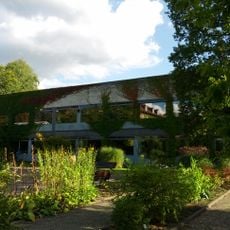
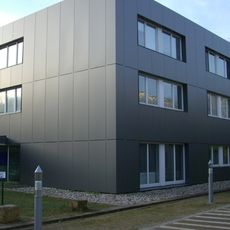
Oblatenkloster, Monastic complex in Rotenbühl district, Saarbrücken, Germany.
The Oblatenkloster is a former Oblate monastery in the Rotenbühl district of Saarbrücken, built in 1928 to plans by architect Moritz Gombert in a plain, abstracted historicist style. Its L-shaped complex incorporates the monastery church of Maria von der Immerwährenden Hilfe, a rectangular hall spanned by a barrel vault that flattens toward the sides. A long lancet arch reaching the floor separates the choir, and low side aisles open through pointed arches; a simple low bell tower adjoins the church.
The monastery was built in 1928 under the design of architect Moritz Gombert as a new religious community center. It was completed before the Maria Queen Church arose nearby decades later to serve the same Catholic population.
The church is dedicated to Maria von der Immerwährenden Hilfe (Our Lady of Perpetual Help), a title of Mary widely venerated in Catholic devotion. The monastery served as a pastoral centre and monastic parish for local Catholics until the new parish church Maria Königin opened in 1959. The building is now empty and unused, so visitors cannot enter or experience any active religious practice there.
The monastery stands in the Rotenbühl residential quarter of Saarbrücken, at coordinates 49.24401, 7.01994. The L-shaped complex and its church are empty since the Oblates left in 2011, and no reuse plan has been carried out, so the interior is not open to visitors. The church furnishings were sold off after closure; only the plain stone high altar remained.
A large organ with 19 registers built in 1937 was removed from this building and now stands in a church in Poland. The relocation of this instrument shows how religious objects travel between countries when circumstances at a site change.
The community of curious travelers
AroundUs brings together thousands of curated places, local tips, and hidden gems, enriched daily by 92,892 contributors worldwide.