Harzkornmagazin, Town hall in a former grain magazine in Osterode am Harz, Germany
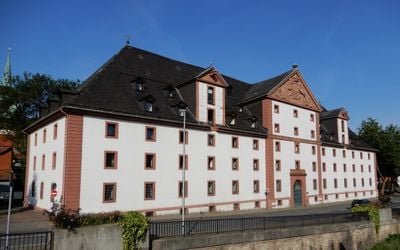
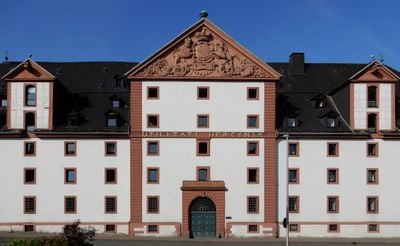
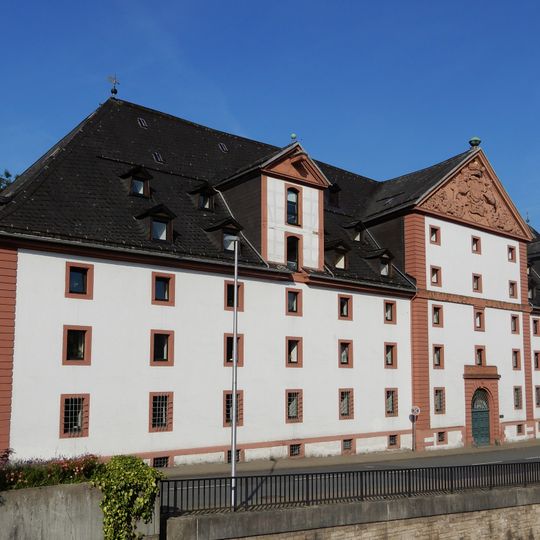
The Harzkornmagazin is a Baroque former grain magazine in Osterode am Harz, now the town hall. Its white rendered facade has reddish-brown stone window surrounds and a steep dark slate roof with small dormer windows; a triangular gable with relief carvings sits above an arched green double door. The wide front carries red sandstone corner pilasters, a gilded inscription "UTILITATI HERCYNIAE" and a pediment with a sculpted coat of arms.
Plans for a grain magazine dated from 1704 and were confirmed in 1712; construction began in 1720 under Christian Georg Vick after his brother Sudfeld's death, and the building was completed in 1722 at a cost of 25,738 talers. It stored up to 2,000 tonnes of bread grain on seven levels until 1911, was damaged in World War II when the nearby Johannistorbrücke was blown up, and was converted into the town hall from 1984, opening in 1989.
The gilded facade inscription "UTILITATI HERCYNIAE" sits above a red stone plaque recording that the building was erected at the expense of George III, King and Elector, in 1782. Grain bought in the Harz foreland and Saxony was sold to miners and smelters at fixed prices even when market prices rose.
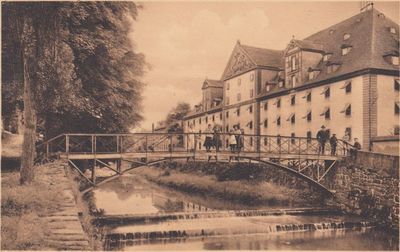
The town hall entrance is the former cart gateway, now a restored hall leading to both wings and the lifts. The gilded "UTILITATI HERCYNIAE" inscription and the plaque naming George III and 1782 sit high on the facade, best read from across the street. The building stands by the Söse and Mühlengraben, near the Johannistor bridge site.
The building's 16-metre binder beams sagged under the weight of stored grain; when the floorboards were removed in 1984, they lifted back almost to their original shape, so the planned levelling work was dropped. The 1722 shell cost 25,738 thalers against an estimate of 15,000.
The community of curious travelers
AroundUs brings together thousands of curated places, local tips, and hidden gems, enriched daily by 93,170 contributors worldwide.