Cultural heritage D-7-7829-0028 in Tussenhausen, Deserted castle site in Tussenhausen, Bavaria, Germany
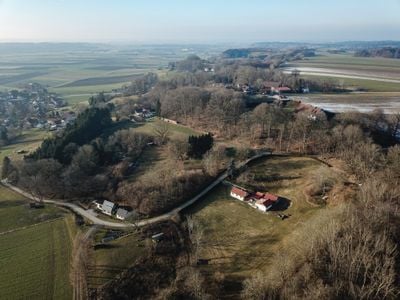
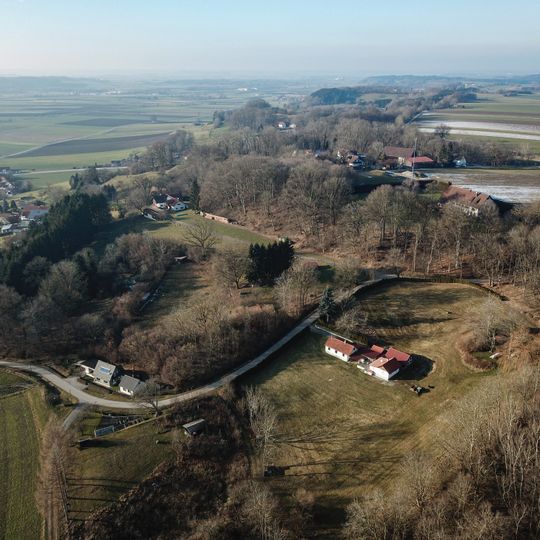
Burg Angelberg is a vanished hilltop castle on a spur above the Flossach valley, about 500 metres north-northeast of Tussenhausen's church. No walls or ruins stand today; what remains is a levelled plateau falling in terraces toward the village, a visible neck ditch on the northeast side, and a curved rampart enclosing the former outer bailey. The site is a protected archaeological monument.
Burg Angelberg was built around 1200, when Heinrich and Conrad von Angelberg, sons of the Welf ministerialis Conrad von Mazzensiez, fortified the ridge. Augsburg destroyed it in 1368 over toll rights on the Lech, and peasants burned it on 22 April 1525 during the Peasants' War; it was rebuilt both times. The remaining structures were demolished after 1742, and the tower was taken down in 1829.
The name Angelberg comes from the ministerial family von Angelberg, first mentioned around 1200. The site is now a Bodendenkmal under Bavaria's 1973 heritage law. Visitors can see the flattened terraces, the neck ditch and a curved rampart of the former outer bailey, and an information board explains the castle's history.
The site lies beneath the current ground surface and is not directly accessible or visible for walking visits. Those interested in learning more can find research and documentation about the archaeological findings at institutions in Munich.
The site's most tangible relic is a well shaft about 18 metres deep and 1.5 metres across; its modern superstructure was bricked up in 1992. An information board on the spot explains the vanished castle. Stones from the ruins were reused in the 18th century to build the brewery at nearby Mattsies Castle.
The community of curious travelers
AroundUs brings together thousands of curated places, local tips, and hidden gems, enriched daily by 92,784 contributors worldwide.