Old bridge of Wasserstraßenkreuz Minden, Navigable aqueduct in Minden, Germany
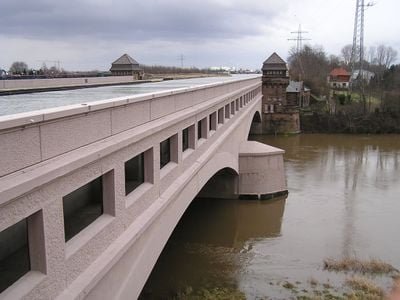
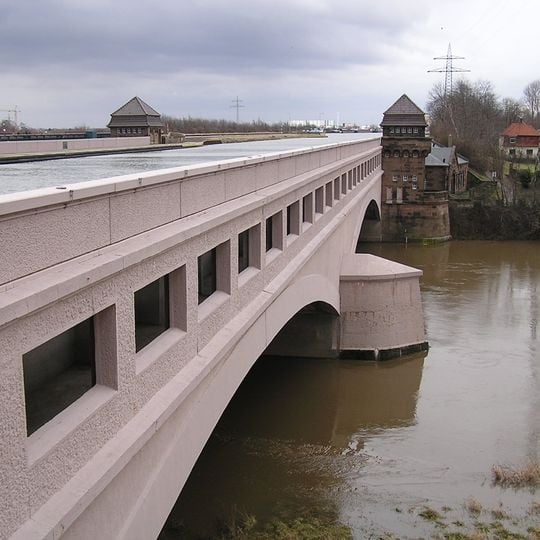
The Alte Kanalbrücke Minden is a 370-metre reinforced-concrete trough bridge carrying the Mittelland Canal over the Weser. Its pale, textured face is clad in sandstone ashlar and pierced by eight three-hinged arches, two of which span the river. A 24-metre-wide, 3-metre-deep water channel runs along the top, bordered by a 2.70-metre service walkway; a dark square tower with a pyramidal roof stands at the right end.
Construction began in August 1911 after Leo Sympher fixed the Mittelland Canal's route; engineers Heinrich Küster and Gereke led the work, and the bridge was first filled with water on 25 May 1914. On 4 April 1945 retreating German troops blew up the waterless structure, dropping both river arches into the Weser. Rebuilding in reinforced concrete started in spring 1947 and the bridge reopened on 18 February 1949.
The bridge is a protected monument since 1987 and part of the Wasserstraßenkreuz Minden, where the Mittelland Canal meets the Weser. Its sandstone facing imitates historicist forms, and the trough's side walls carry a wooden collision guard. The service walkway beside the trough is about 2.70 metres wide and may be used on foot at one's own risk; cycling across is not permitted.
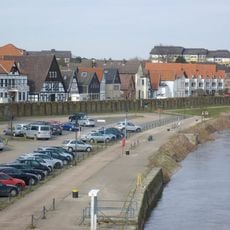
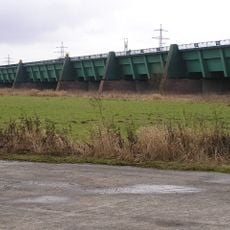
The structure is visible from several viewpoints along the riverbanks and offers clear views of how it is built. To see it working, arrive when boats are using the crossing, especially during daytime hours when traffic is active.
The trough holds about 24,000 tonnes when filled, with a water surface 24 metres wide and 3 metres deep. Its seal is asphalt felt under a 2 mm lead skin, then 10 cm of clay and 10 cm reinforced concrete slabs. A 2.70 m service walkway runs beside the trough; walking is at your own risk and cycling is not allowed.
The community of curious travelers
AroundUs brings together thousands of curated places, local tips, and hidden gems, enriched daily by 94,623 contributors worldwide.