St Johannis, Church building in Minden, Germany
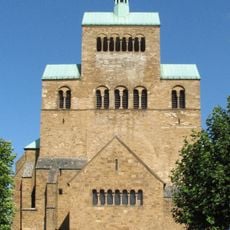
St. Johannis is a church building in Minden, built in the 12th century as a three-aisled Romanesque vaulted basilica; the side aisles and transept arms were removed around 1800, so it has been single-aisled since then. Its square tower received two octagonal brick storeys in the second half of the 15th century, stripped of plaster in 1979/80. The bricks measure 32–33 cm long and 7–8 cm high, and the tower vault is also brick.
St. Johannis was founded around 1200 as a collegiate foundation of St. John the Evangelist by Bishop Dietmar von Stromberg (1185–1206) and the Minden canon Ramward. In 1529 the Protestant citizens took over the church; after the Schmalkaldic War the canons recovered it in 1548. In 1628 the bishop assigned it to the Franciscans, who were expelled by the Swedes in 1634. The Kingdom of Westphalia dissolved the foundation in 1810, and from 1824 the Prussian army used the building as an arsenal.
The collegiate foundation was dedicated to John the Evangelist, not the Baptist. Since 1978–1981 the former church has served as the BÜZ citizens' centre, hosting cultural events; the building passed into the city's ownership before that restoration.
St. Johannis stands in Minden's old town, a short walk from the town centre. Since the side aisles and transept arms were removed around 1800, the interior is a single hall, so the former basilica layout is no longer visible. The building now serves as the Bürgerzentrum BÜZ and is used for cultural events rather than regular services.
From 1796 to 1801, the Prussian army used the nave as a grain storage facility. Local people protested against this use because they wanted to keep choir services going.
The community of curious travelers
AroundUs brings together thousands of curated places, local tips, and hidden gems, enriched daily by 93,638 contributors worldwide.