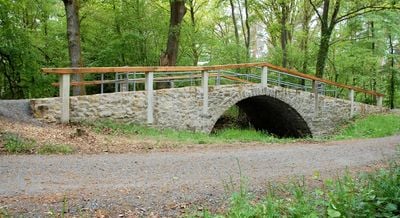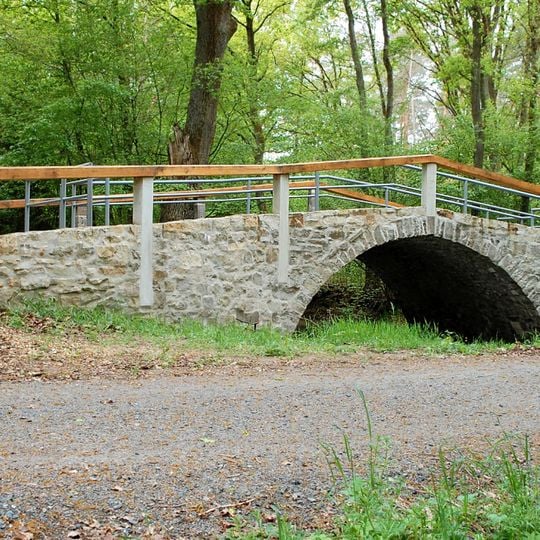
Napoleonsbrücke, Road bridge in Gifhorn, Germany.
Napoleonsbrücke is a road bridge in Gifhorn that spans a watercourse with its stone vault and dates back to 18th‑century building techniques. The bridge extends roughly 62 ft (19 m) and displays the period's typical arch construction of dressed stone.
Construction took place around 1750 and reflects a phase of road network expansion in Lower Saxony before industrialization. The designation as Napoleonsbrücke was added later, possibly in memory of the French occupation at the beginning of the 19th century.
The name rests on the tradition that Napoleon crossed the bridge in 1803, during the occupation of the Electorate of Brunswick-Lüneburg, and again in 1806 with his troops. Since the bridge was closed to motor traffic in 1989 and a parallel crossing was built, it has no traffic function; an information board stands beside it.
The bridge stands about four kilometres southwest of Gifhorn's centre in woodland, cut off by the Berlin–Lehrte railway and the B4. Only service roads lead to it, and since 1989 motor vehicles have been barred; a modern metal barrier added in 2019 blocks cars. A parallel crossing beside the bridge carries the Bohlenriede stream.
The bridge rests on a pile foundation of oak trunks sunk into the ground, and its parapet is fixed to dressed stone blocks set into the masonry. Since 2019 a modern metal barrier has blocked vehicles, after the city built a parallel crossing in 1989 when the span could no longer carry motor traffic.
The community of curious travelers
AroundUs brings together thousands of curated places, local tips, and hidden gems, enriched daily by 94,004 contributors worldwide.