Roter Turm, Cylindrical tower at Belvedere Palace, Germany
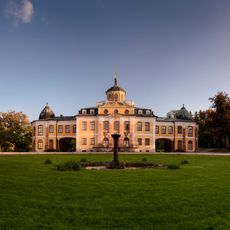
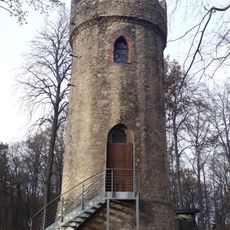
The Roter Turm is a small round pavilion with a conical roof beside the New House at the end of the Belvedere orangery. Its name comes from the red-painted bricks of its outer walls, while the load-bearing wall behind is timber-framed, built cheaply. A short passage links it to the New House, and inside, a painted ceiling shows a cloudy sky.
The tower began as part of Weimar's town fortifications; from 1775 Duchess Anna Amalia had it converted into a pavilion decorated with chinoiseries. It stood in the English Garden near the Wittumspalais, where it appears on Johann Friedrich Lossius's 1785 town plan. Goethe directed its dismantling and reconstruction at Belvedere between 1818 and 1822, to designs by Carl Friedrich Christian Steiner.
The six chinoiserie frescoes inside are not Adam Friedrich Oeser's originals: they are copies made up to 1821 by Johann Joseph Schmeller, who worked from watercolours by Johann Sebastian Carl Brandt and surviving original sections. Oeser had supplied both the paintings and the idea for the pavilion. The flat ceiling is painted as a cloudy sky.
The tower sits within the Belvedere Palace grounds and is easiest to reach from the main palace pathway. Visitors should note that interior access typically requires a guided tour and follows limited opening times.
The tower's ceiling is painted as a cloudy sky, a detail easy to miss when looking at the frescoes. The six chinoiserie frescoes visible today are not Adam Friedrich Oeser's originals: they are copies made by Johann Joseph Schmeller up to 1821, based partly on watercolours by Johann Sebastian Carl Brandt.
The community of curious travelers
AroundUs brings together thousands of curated places, local tips, and hidden gems, enriched daily by 93,114 contributors worldwide.