Fahnenburg, Demolished villa site in Ludenberg, Düsseldorf, Germany
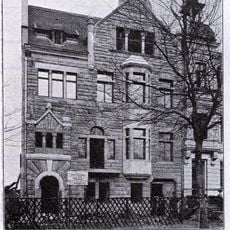
Fahnenburg was a rectangular residential building with a central observation tower and decorative stonework at its four corners. The original structure was later expanded into a larger villa with gallery spaces to display artworks.
Anton Fahne built this forester's residence in 1846 and expanded it into a substantial villa a decade later. The property became an important cultural landmark in the Rath district during the 1800s.
The name Fahnenburg combines Anton Fahne's surname with the castle-like look of his 1856-57 extension, which had round-arched arcades, battlements and a balustraded terrace with vases and sculptures. The grounds hosted the Düsseldorf School of Painting's artist festivals of 1840, 1846 and 1850; the 1851 festival staged a costumed procession, "Prinz Rebensaft", from the city to the house.
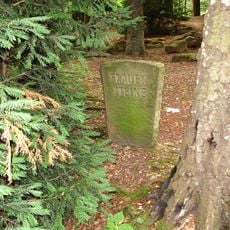
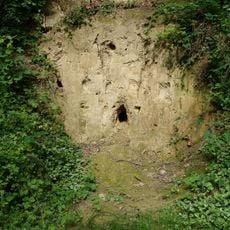
The site lies at a path junction below Haus Roland, on the transition between the Aaper and Grafenberger woods. The Fahnenburg was demolished in the 20th century; the present Anton-Fahne-Weg and Fahneburgstraße in Ludenberg recall it. The street named after it required a deep cutting north of the Rolander Weg in the late 1920s.
When the ground was levelled for a horse stable south of the house on 18 May 1849, several urns were reportedly found, according to Anton Fahne himself. The site later housed his painting gallery, whose collection was auctioned in 1932 as Düsseldorf's largest private art collection.
The community of curious travelers
AroundUs brings together thousands of curated places, local tips, and hidden gems, enriched daily by 93,972 contributors worldwide.